Choosing the right digital experience platform (DXP) is a critical decision for any enterprise aiming to enhance customer engagement, streamline operations, and achieve digital transformation goals. Among the top contenders, Liferay and Drupal are widely recognized for their capabilities. While both platforms offer robust features, this blog will analyze their strengths and demonstrate why Liferay is the smarter choice for enterprises.
The honest answer is that they are built for different things. Liferay is an enterprise platform that goes well beyond just managing content. Drupal is a powerful content management system with a lot of flexibility, but it still operates mainly as a CMS. This blog breaks down both platforms in plain language so you can figure out which one actually fits what you need.
What is Liferay?
Liferay is a Digital Experience Platform (DXP) that goes beyond traditional content management by combining content management, user administration, access control, workflow automation, and enterprise integrations in a single platform.
It enables organizations to deliver personalized digital experiences while managing complex business processes, multiple websites, user groups, and organizational structures from a centralized system.
What is Drupal?
Drupal is a widely used open-source Content Management System (CMS) known for its flexibility, extensibility, and ability to manage complex content structures and publishing workflows. Since its launch in 2001, it has become a popular choice for government agencies, educational institutions, media organizations, non-profits, and other content-driven websites.
Its developer-friendly architecture supports extensive customization, integrations, and the management of large volumes of content, making it well suited for sophisticated web projects and content-rich digital platforms.
DXP vs CMS: Why It Matters
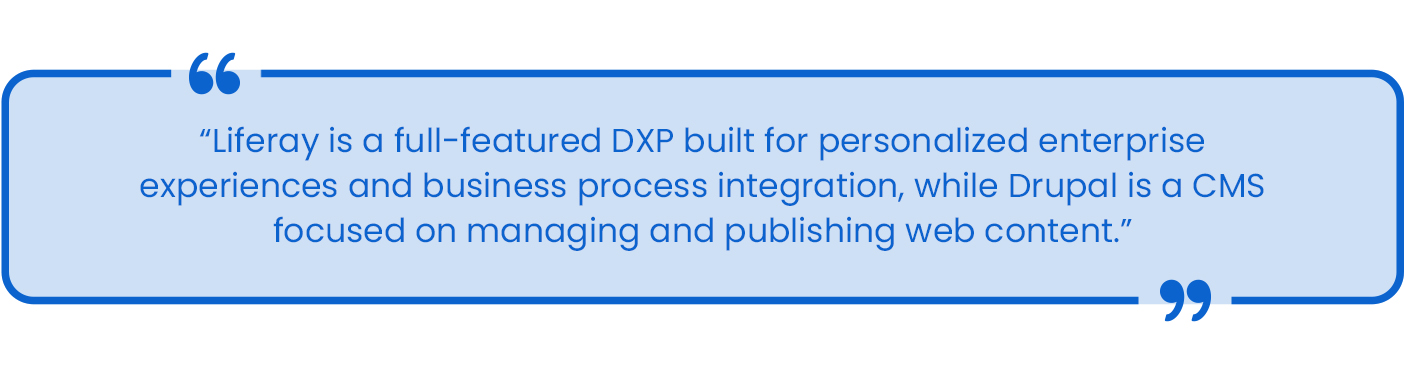
This is probably the most important difference between the two platforms, and it is worth understanding before anything else.
Liferay is a DXP plus CMS. It covers content management, but it also covers user management, workflow automation, multi-site management, system integrations, and role-based access control. All of this comes built in, not as add-ons.
Drupal is a CMS. A very capable one, but still a CMS. If you need enterprise features like proper user portals, automated workflows, or integration with systems like SAP or Salesforce, you will need to build or add those things yourself through custom development or contributed modules.
For a content-heavy website, Drupal can be a strong choice. But for a platform that needs to do real business work, Liferay is already set up for that from day one.
Comparison Criteria
To provide a comprehensive comparison, we will evaluate Liferay and Drupal based on the following parameters:
- Enterprise Architecture
- Integration Capabilities
- Ease of Use
- Customization Capabilities
- Scalability and Performance
- Cost and Licensing
- Community Support and Ecosystem
Quick Comparison: Liferay vs Drupal
| Feature | Liferay | Drupal |
| Enterprise Architecture | Built for enterprise environments | Requires additional setup for enterprise needs |
| Integration Capabilities | Strong native integrations | Relies on modules and custom integrations |
| Ease of Use | User-friendly for business teams | More developer-oriented |
| Customization Capabilities | Structured and scalable customization | Flexible but development-heavy |
| Scalability & Performance | Enterprise-grade scalability | Requires tuning for large-scale deployments |
| Cost & Licensing | Free and Enterprise editions available | Free to use but higher implementation effort |
| Community Support & Ecosystem | Enterprise support and partner network | Large open-source community |
Enterprise Architecture
- Liferay
Designed for large enterprises, Liferay offers built-in multi-site management, clustering, caching, and robust role-based permissions, ensuring performance, reliability, and secure operations at scale.
- Drupal
Drupal can handle large-scale setups, but achieving enterprise-level features like multi-site management and fine-grained access control requires custom configurations, extra modules, and experienced developers.
Integration Capabilities

- Liferay
Liferay offers strong built-in integration capabilities, including REST and GraphQL APIs, support for LDAP, SAML, and OAuth2, seamless connections with enterprise systems like SAP, Salesforce, and Microsoft 365, and a headless architecture for omnichannel delivery.
- Drupal
Drupal supports integrations through APIs and contributed modules, but complex connections with ERP, CRM, and other enterprise systems often require significant custom development and additional effort.
Ease of Use

- Liferay
Liferay may need more initial setup due to its enterprise features, but once configured, it offers a user-friendly experience with drag-and-drop page design, role-specific interfaces, and content workflows, supporting efficient collaboration across teams and sites.
- Drupal
Drupal is developer-friendly but less intuitive for non-technical content editors; the admin interface often requires customization to be user-friendly, though experienced teams can optimize it for smooth editing.
Customization Capabilities

- Liferay
Liferay’s modular Java/OSGi architecture allows developers to create custom modules, workflows, and reusable UI components, with robust APIs for integration, making customizations scalable, maintainable, and enterprise-ready.
- Drupal
Drupal offers flexible content customization through custom modules and content types, but extending beyond content—like workflows, roles, or multi-organization structures—requires substantial custom development.
Scalability and Performance

- Liferay
Liferay is built for enterprise-scale environments, offering native support for multi-site, multi-tenant, and multi-organization setups, along with built-in clustering, load balancing, and caching for high performance and reliability.
- Drupal
Drupal can scale effectively for large, content-heavy websites with proper infrastructure and caching, but it often requires additional optimization and is better suited to content-focused platforms than complex enterprise applications.
Cost and Licensing
- Liferay
Liferay offers a free Community Edition and a paid Enterprise Edition with professional support, security updates, and SLAs, making it suitable for organizations that need reliability and expert-backed long-term maintenance.
- Drupal
Drupal is fully open source with no licensing cost, but enterprise implementations often require custom development, contributed modules, hosting, and experienced developers, making long-term costs significant.
Community Support and Ecosystem
- Liferay
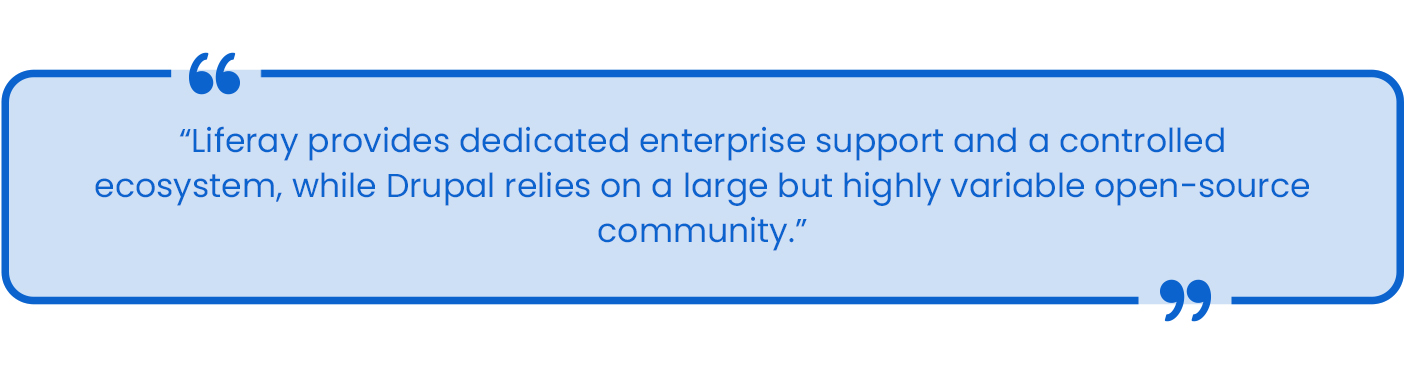
Liferay’s community and ecosystem focus on enterprise digital experiences, offering targeted forums, official documentation, tutorials, certified partners, and vendor support for complex implementations.
- Drupal
Drupal has a large, active open-source community with extensive modules, forums, and events, but enterprise-focused guidance for complex workflows or integrations often requires specialized agencies or custom development.
Why Organizations Choose Liferay
- Enterprise portals, self-service platforms, and digital workplaces.
- Seamless integration with ERP, CRM, legacy systems, and third-party applications.
- Flexible customization, low-code development, and composable architecture.
- Built-in CMS, workflows, document management, and user management capabilities.
- Multi-site, multilingual, and multi-brand digital experience delivery.
- Lower total cost of ownership with flexible cloud and on-premise deployment options.
Where Drupal Excels
- Content-focused websites and publishing platforms.
- Flexible content modeling through custom content types.
- Large open-source community and module ecosystem.
Conclusion
Both platforms are solid. But they are built for different jobs.
If you are building a content-heavy website, a media portal, a university site, or anything where the focus is publishing and managing content, Drupal is a strong choice. It is flexible, well-supported by the community, and free to use.
But if you are building something bigger, like a customer portal, an employee intranet, a government service platform, or any system where users need accounts, approvals need to happen, and software systems need to talk to each other, Liferay is the better platform. It was built for exactly that kind of work.Drupal manages content well. Liferay manages content and runs your business processes at the same time. That is the real difference.
FAQ
What is the main difference between Liferay and Drupal?
Liferay is a Digital Experience Platform built for enterprises. It handles user management, workflows, integrations, and content all in one system. Drupal is a content management system that is flexible and powerful, but it is focused primarily on managing and publishing content.
Is Drupal good enough for enterprise use?
Drupal can work in enterprise environments, especially for large content-driven websites. But for things like user portals, complex access controls, business workflows, and system integrations, it requires a lot of custom development. Liferay handles all of that out of the box.
Is Liferay free?
Liferay has a free Community Edition that is open source and suitable for developers and smaller projects. The Enterprise Edition is a paid subscription and includes official support, SLAs, and regular security updates.
Which platform is easier to work with for non-technical users?
Neither platform is designed for complete beginners. Liferay, once set up, gives content editors a cleaner and more structured experience with built-in workflows and role-based views. Drupal’s admin interface is generally more developer-oriented, though it can be improved with customization.
Which platform is better for system integrations?
Liferay is better. It has native REST and GraphQL APIs, LDAP, SAML, OAuth2 support, and built-in connectors for enterprise systems like SAP and Salesforce. Drupal can integrate with external systems too, but it usually requires more custom development and contributed modules to get there.
Who should choose Liferay over Drupal?
Any organization that needs more than a website. If you need user portals, employee intranets, workflow approvals, multi-department management, or deep integrations with enterprise software, Liferay is the right choice. If you mainly need a well-structured content website, Drupal is worth considering.