Liferay DXP 2026.Q3 is more than just another quarterly feature update. The release brings new capabilities across solutions, including AI Hub, Liferay Data Platform (LDP), and Digital Sales Room (DSR), all of which have reached general availability (GA) status.
Additionally, Cloud Native offers support for Google Cloud Platform and Kubernetes-ready environments, while the Content Marketing Platform is now fully supported and production-ready. All these advancements and changes enable organizations to build, manage, and optimize digital experiences from a connected platform.
Everything below is based on Liferay's own 2026.Q3 release webinar, announced here and now available as a replay with the presentation PDF.
However, the real question is not what’s new; it’s what we should turn on first. Below, we walk through each of these capabilities in plain, simple terms to help you understand which new features have been introduced and how you can maximize their benefits.
What’s New in Liferay DXP 2026.Q3?
The release expands Liferay's capabilities across several core areas. Here are the updates that deserve the most attention.
1. AI Hub: AI Built into the Platform, Not Bolted On
AI is one of the most significant themes in the 2026.Q3 release.
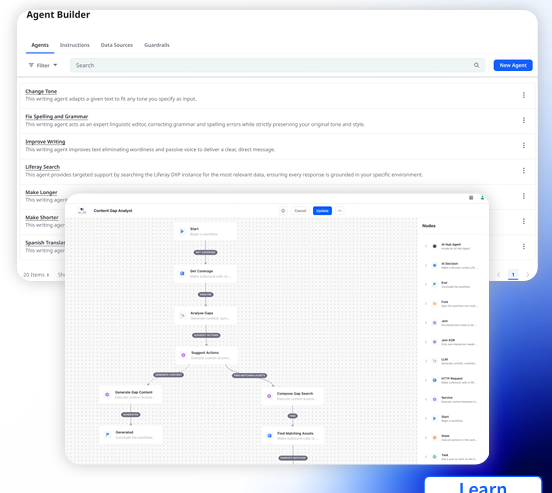
AI Hub reached General Availability in this release. It is introduced as a standalone, low-code SaaS product for building and managing AI agents. It includes a visual builder and a library of Liferay-managed agents. Importantly, organizations don't need to have Liferay DXP installed to use AI Hub. Agents can be deployed on external sites and connected to external systems.
The release also emphasizes AI governance. Google Model Armor can inspect inputs and outputs for prompt injection and data leaks, while organizations can configure the tone and behavior of their agents.
Practically, that means you can deploy chatbots on any site, no DXP required, and connect agents to external systems. AI Hub also supports retrieval-augmented generation using context from external websites, reducing the need to manually upload information. And because it is LLM-agnostic, organizations can use the language model they prefer.
For businesses exploring AI assistants, chatbots, and agent-based experiences, this creates a more accessible path from experimentation to deployment.
2. Liferay Data Platform: From Customer Data to Personalization
Liferay Data Platform has also hit General Availability this quarter. It is considered one of the most consequential releases because it brings analytics and CDP capabilities together, so teams can understand, segment, and activate customer data from one place.
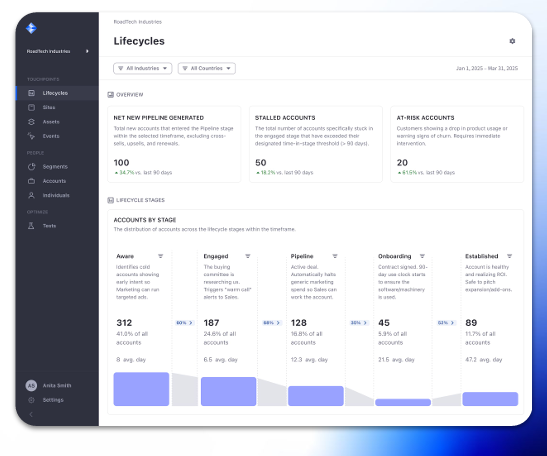
The platform can ingest and resolve fragmented information from anonymous intent sources and known systems such as Salesforce, Marketo, and HubSpot.
Teams can generate attributes such as engagement level, account lifecycle stage, and interests. They can also create real-time segments using behavioral data, custom events, CRM and Martech data, and webhooks.
One particularly useful capability is the Account Lifecycle Dashboard, which tracks six stages: Aware, Engaged, Pipeline, Onboarding, Established, and At-Risk.
Those segments can then feed Liferay DXP personalization, allowing organizations to tailor content, journeys, and experiences.
The result is a tighter relationship between customer data and digital experience—and potentially less dependence on a standalone CDP.
3. Content Marketing Platform: Connect Campaigns and Content Within the DXP
Marketing teams often manage campaigns across multiple tools, while the actual content lives somewhere else. Liferay's Content Marketing Platform (CMP) aims to bring these activities closer together.
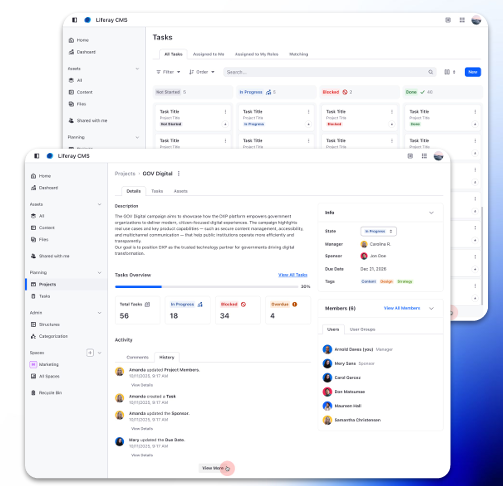
CMP is a marketing add-on to the Headless CMS that organizes campaigns into Projects and Tasks, with CMS assets directly connected to the work being performed. It is fully supported and usable in production, one step short of full GA. Therefore, it should be treated as production-ready while expecting further refinement over the coming quarters.
Teams can assign tasks, collaborate through contextual comments, maintain activity histories, and work through Calendar or Kanban views. Built-in approvals also provide visibility into campaign progress.
The practical benefit is straightforward: marketing teams can plan and execute campaigns while keeping the content connected to the process.
4. Digital Sales Room: A More Connected B2B Buying Experience
B2B buying journeys involve multiple stakeholders, documents, approvals, and conversations. The new Digital Sales Room, which reached GA in 2026Q3, provides a secure, collaborative environment designed to centralize that deal journey.
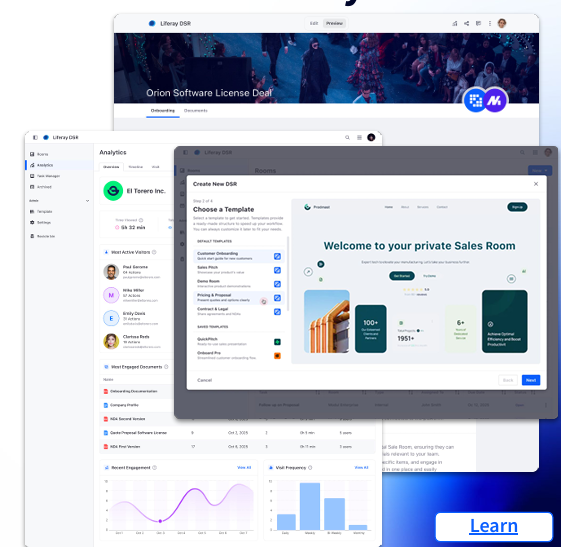
DSR creates shared buyer-seller collaboration spaces and personalized microsites that centralize documents, approvals, and communication for a single deal, with engagement analytics showing which stakeholders are active and which documents get the most attention.
Digital Sales Room is a powerful and handy asset for all those organizations that operate and run dealer, partner, and customer portals on Liferay DXP. Engagement analytics help sales representatives understand which stakeholders are most active, and which documents receive the most attention. That information can support more targeted follow-ups.
The experience is also designed to reduce IT dependency. A no-code site creation flow allows non-technical users to create sales rooms, while updated GA capabilities include duplicate, archive, restore, faster administration, time-limited access, and more granular permissions.
For B2B organizations, this moves the digital sales experience beyond simply sharing documents or sending links. The sales room becomes a dedicated environment for progressing the deal.
5. Cloud Native: GA for GCP and Kubernetes-Ready Environment
Infrastructure modernization is another major part of the 2026.Q3 story.
Liferay confirmed GA support for GCP Ready and Kubernetes Ready in its 2026.Q3 webinar announcement.
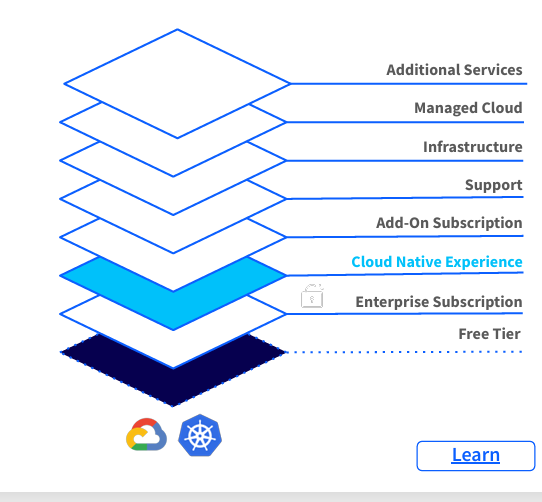
The new Cloud Native capability provides a Liferay Toolkit for deploying Liferay DXP on Google Cloud Platform or any compliant Kubernetes distribution, including OpenShift.
The approach provides standardized tooling for Google Kubernetes Engine and supports Kubernetes environments. Organizations also gain deployment flexibility between managed GCP infrastructure and provider-agnostic Kubernetes platforms.
Another important benefit is visibility. Teams can see Liferay DXP alongside other applications running in the cluster, while a standardized deployment approach can help make setup and ongoing maintenance more predictable.
For organizations already adopting Kubernetes or planning a cloud modernization initiative, this makes Liferay easier to position within a broader cloud-native architecture.
What Else Makes the Headlines in This Liferay 2026.Q3 Release
The 2026.Q3 release isn't limited to the five capabilities above.
For example, the new Production Readiness Dashboard automatically checks configurations against Liferay's production deployment standards and flags security, performance, and configuration issues before launching.
Liferay also introduces Design Libraries, allowing teams to maintain Style Books and Fragments centrally and make them available across multiple sites. This can help organizations maintain brand consistency without updating every site individually.
For upgrades, new visibility and monitoring capabilities provide row-level progress logging and stall detection for database upgrades. Administrators can see how many rows have been processed and distinguish a genuinely blocked query from one that is simply taking longer than expected.
Security and privacy also receive attention. Liferay 2026.Q3 adds GA integration with third-party Consent Management Platforms such as OneTrust, Usercentrics, and Cookiebot, supporting capabilities including automated scanning, auto-blocking, consent change logging, multi-regulation support, and geo-targeting.
What This Means for Your Upgrade Plan
This is an easy part of 2026.Q3 to overlook, but it’s important. Liferay now releases four updates a year, so the old approach of doing one major upgrade every 18 months no longer works well.
By the time a team plans and completes one big upgrade, several quarterly releases have already passed. This can leave the version they upgrade to outdated as soon as it goes live.
The better approach is to make smaller upgrades more often and plan for them every quarter instead of once a year.
Business enterprises should take these crucial steps:
- Assess your data layer Set up LDP first before adding personalization or AI.
- Choose your AI use cases Start with three AI Hub use cases that have clear and measurable results.
- Improve your portals with DSR If you have a dealer, partner, or customer portal, DSR is an easy way to add better collaboration.
- Plan for the next steps Build these updates gradually instead of trying to change everything at once.
Where Surekha Technologies Fits In
Surekha Technologies is an Official Liferay Partner offering end-to-end consultation, implementation, integration, migration, and upgrades.
If you are still wondering where to start with the 2026.Q3 release, a one-to-one strategic upgrade consultation with our Liferay experts can help you plan your next upgrade with confidence.
Final Thoughts
Liferay DXP 2026.Q3 is more than just another quarterly feature update. It expands the platform's role across AI, customer data, marketing, sales, and cloud infrastructure while continuing to improve the core administration and development experience.
Whether the priority is introducing AI agents, creating more connected personalization, modernizing B2B sales journeys, improving campaign operations, or moving toward Kubernetes-based deployment, 2026.Q3 offers several capabilities worth evaluating for the next Liferay roadmap.
For the full walkthrough from Liferay's product team, the 2026.Q3 release webinar replay includes the recording and slides.
FAQ
What are the key features introduced in Liferay DXP 2026.Q3?
Liferay DXP 2026.Q3 brings major updates across AI, customer data, digital sales rooms, cloud-native deployments, and campaign management. Key highlights include AI Hub, LDP, DSR, Cloud Native support for GCP and Kubernetes, and the move of CMP into Release status.
Is Liferay AI Hub available in GA?
Yes. AI Hub reached GA in 2026.Q3. It is a standalone, low-code SaaS product for building and managing AI agents, with capabilities such as a visual agent builder, RAG, chatbot deployment, and LLM flexibility.
What is Liferay Data Platform (LDP), and why does it matter?
LDP combines analytics and customer data capabilities to create unified customer and account profiles. It brings together behavioral, CRM, marketing, and other data to create real-time segments that can support personalized digital experiences.
What is Liferay Digital Sales Room (DSR) used for?
DSR enables organizations to create personalized microsites that bring documents, approvals, engagement analytics, and buyer interactions into one place. It can be particularly useful for dealer, partner, and customer-facing sales journeys.
Should organizations upgrade to Liferay DXP 2026.Q3 immediately?
Not necessarily. The better approach is to evaluate which 2026.Q3 capabilities align with your business priorities and upgrade plan. For organizations considering AI initiatives, our recommendation is to assess the data layer first, then identify practical AI use cases before expanding into capabilities such as DSR.