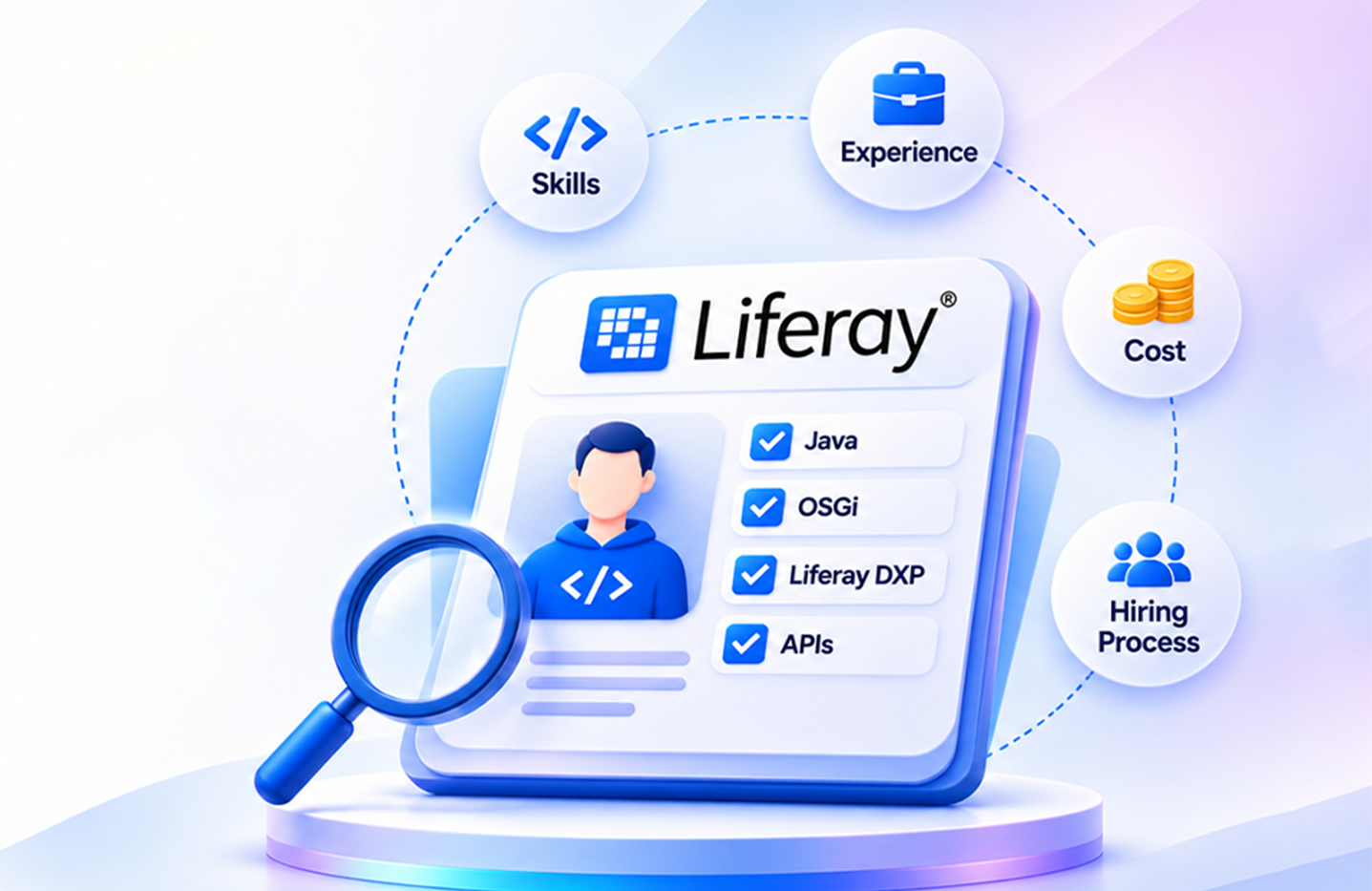
Not every part of an enterprise portal needs a fresh start. Some applications still serve their purpose; certain workflows need reworking, and others may no longer support how a business operates. Knowing the difference is often the first challenge in portal modernization. Replacing too much adds unnecessary development work, while retaining outdated components limits future improvements.
This is why modernization requires developers who can look beyond individual coding tasks and understand the bigger picture. When businesses hire Liferay developers for enterprise portal modernization, they need people who can assess existing functionality, understand application dependencies, and determine how new requirements fit the current environment.
From reworking legacy applications to developing new portal capabilities, the right technical decisions can help enterprises modernize with a clear purpose rather than making changes simply to use newer technology.
What to Define Before You Hire Liferay Developers for Portal Modernization
Before starting an enterprise portal modernization project, businesses need a clear understanding of what they expect the updated platform to accomplish. Without defined objectives, development decisions can become driven by individual technical preferences rather than actual business requirements. This can lead to unnecessary changes, overlooked functionality, or development work that does little to improve how people use the portal.
A good starting point is to examine the portal from the perspective of the people who depend on it and the business processes it supports.
Identify the Needs of Different Portal Users
Enterprise portals often serve multiple audiences, and each group may have different expectations. For example:
- Employees: Easier access to HR services, internal documents, departmental resources, and approval workflows.
- Customers: Convenient account management, application tracking, service requests, and access to relevant information.
- Business partners: Shared resources, transaction information, partner-specific services, and communication channels.
- Administrators: Better control over portal content, user permissions, departmental access, and routine management activities.
Understanding these differences helps determine which experiences and functionalities should be prioritized during modernization.
Examine Dependencies on Existing Business Applications
A portal rarely operates independently of an organization's other systems. It may exchange information with CRM, ERP, HRMS, document management platforms, and third-party applications.
Before defining the modernization scope, consider:
- Which business applications need to remain connected to the portal?
- Are users required to switch between multiple systems to complete routine activities?
- Which applications should exchange information in real time?
- Are there existing integrations that need modification or replacement?
These considerations help shape the technical requirements of enterprise portal modernization and prevent important dependencies from being overlooked.
Account for Future Business Requirements
Modernization planning should also consider what the organization may need beyond its immediate requirements. This could include introducing additional digital services, supporting new user groups, expanding self-service functionality, or connecting applications that currently operate independently.
Once these priorities are established, businesses can hire Liferay developers with a clearer understanding of the expected responsibilities and project scope. Developers can translate business requirements into technical specifications and identify the appropriate expertise needed to execute them.
This also helps businesses identify relevant Liferay Development Services, particularly when modernization involves application redevelopment, portal customization, or enterprise system integrations.
The objective is simple: define what the portal needs to achieve before deciding what to develop. This gives every modernization decision a clear business purpose.
Hire Liferay Developers Who Can Understand Your Entire Enterprise Portal Ecosystem
An enterprise portal is rarely a standalone application. It operates within a larger technology environment where multiple business systems, applications, data sources, and services exchange information.
A change to one part of this environment can influence how other components function. For this reason, developers need to understand the relationships between these systems before deciding on portal architecture or redevelopment.
When businesses hire Liferay developers for enterprise projects, one important consideration is their ability to look beyond the portal's immediate functionality and understand the broader application ecosystem.
Examine How Existing Systems Connect and Exchange Information
Before recommending changes, developers should examine the systems that contribute to the portal's functionality. This includes understanding where information originates, how applications consume it, and which dependencies must remain intact.
An enterprise portal may involve several interconnected components:
- Business applications: ERP, CRM, HRMS, and financial systems that support departmental operations.
- Content and document repositories: Platforms that store business documents, policies, product information, and organizational resources.
- Identity and access management: Authentication services, single sign-on (SSO), and role-based access controls that determine how users access different applications.
- External services: Payment gateways, notification services, third-party APIs, and other platforms that provide additional functionality.
Understanding these relationships helps developers identify dependencies that might otherwise be overlooked during Liferay Portal Modernization.
Understand the Impact of Changes Across Connected Applications
Consider an enterprise portal that retrieves customer information from a CRM, processes transactions through an ERP, and provides documents through an external repository. If the portal's data exchange mechanisms or application interfaces change, the impact may extend beyond the portal itself.
Experienced Liferay Developers for Enterprise Applications should be able to examine these dependencies, identify potential integration issues, and determine how to introduce changes without disrupting existing business operations.
This broader understanding also influences architectural decisions, integration planning, and the development work required at different stages of modernization.
The objective is not to make every connected system part of the redevelopment project. It is to understand how the existing environment works well enough to modernize the portal without creating unnecessary dependencies or complications elsewhere.
Work with Liferay Developers to Decide What to Retain, Rework, Replace, or Introduce
One of the more consequential decisions in enterprise portal modernization is determining how much of the existing environment needs to change. Replacing every legacy component may seem like a fresh start, but it can also increase development effort, introduce new dependencies, and discard functionality that still serves the organization well. On the other hand, retaining everything simply because it already exists can restrict future development.
This is where technical assessment and informed decision-making become particularly important. Businesses looking to hire Liferay developers should involve them in evaluating existing portal components before finalizing the modernization scope. With the right Liferay Consulting Services, this assessment can help connect business requirements with practical development decisions.
A Four-Way Framework for Modernization Decisions
Rather than treating modernization as a complete replacement exercise, developers can assess individual components against their business value, technical condition, dependencies, and future relevance.
| Modernization Decision | What it involves | When it makes sense |
| Retain | Keep existing applications, modules, or functionality without major redevelopment. | When components remain reliable and meet current requirements. |
| Rework | Modify existing functionality, update code, or improve application behavior. | When the underlying component remains useful but requires changes. |
| Replace | Develop an alternative for an existing component that no longer meets requirements. | When outdated architecture or functional limitations make continued use impractical. |
| Introduce | Add new applications, capabilities, or integrations. | When business requirements cannot be addressed effectively through existing functionality. |
Apply These Decisions to Actual Portal Components
Consider an enterprise portal containing an employee dashboard, an internal document repository, and several custom business applications. The dashboard may still serve employees effectively and only require minor interface changes. The document repository may need improvements to its content organization and access permissions. However, an older custom application built around outdated dependencies might require redevelopment.
In this situation, replacing the entire portal would not necessarily be justified. Each component requires a different decision based on its condition and business purpose.
Businesses should expect developers to make recommendations based on the condition of existing components, their business relevance, and their technical dependencies rather than personal technology preferences. The objective is to preserve useful investments, address genuine limitations, and introduce new capabilities where there is a clear requirement.
A successful modernization initiative is not measured by how much existing technology is replaced, but by how effectively each change serves the portal's future requirements.
Hire Liferay Developers to Modernize Enterprise Workflows, Not Just Portal Components
Having multiple business applications accessible through an enterprise portal does not necessarily make everyday processes easier. Employees may still switch between systems, enter the same information repeatedly, or follow up on requests through emails. These gaps often arise when applications are developed independently without considering how they work together.
During Enterprise Portal Modernization, businesses should look beyond individual applications and examine the workflows they support. For example, an employee onboarding process may involve HR collecting information, managers approving requests, and IT arranging system access. If these activities operate separately, completing the process can involve unnecessary coordination.
Focus on How Users Complete Their Work
Experienced Liferay developers can examine these processes and identify opportunities to improve how users interact with different business systems. This may involve:
- Bringing related tasks and information into a common portal experience.
- Connecting approval workflows with relevant business applications.
- Providing visibility into pending requests and their status.
- Reducing repeated data entry across connected systems.
Develop Around Actual Business Requirements
The objective is not to move every business process into Liferay. It is to determine where the portal can provide a more convenient way to access services and coordinate activities while allowing existing enterprise applications to perform their intended functions.
This distinction makes workflow-focused modernization more meaningful. Instead of simply updating a portal's appearance, businesses can improve how employees, customers, and partners complete their everyday tasks.
How Liferay Developers Can Plan Modernization Without Disrupting Business Operations
For enterprises, portal modernization cannot come at the cost of everyday business operations. Employees, customers, and business partners may continue using the existing portal while development work is underway. Replacing major components or changing application behavior without proper planning can affect services that people rely on daily.
This is why modernization needs to be approached in manageable phases. Businesses that hire Liferay developers should involve them in deciding which components to update first, how existing services will be maintained, and when new functionality can be introduced.
Plan Changes Around Business Priorities
Developers can help divide modernization work into smaller stages based on business importance, technical dependencies, and implementation requirements. This may include:
- Prioritizing critical applications and frequently used portal services.
- Developing new components alongside existing functionality where appropriate.
- Testing interactions between updated and existing applications.
- Scheduling releases to minimize disruption to business activities.
- Preparing fallback and rollback plans for critical changes.
Maintain Continuity During Development and Deployment
Testing should extend beyond checking whether individual components work correctly. Developers also need to verify that connected applications, user permissions, and existing workflows continue functioning as expected after changes are introduced.
A phased approach gives enterprises greater control over modernization, makes issues easier to identify, and allows teams to address problems before moving to subsequent stages.
Ultimately, the objective is to improve the portal without making its users bear the burden of the modernization process.
Hire Liferay Developers Who Understand Enterprise Data and Content Continuity
An enterprise portal holds more than pages and application interfaces. It often contains years of business information, employee records, customer documents, content structures, and access permissions. During modernization, this information must remain accurate, accessible, and available to the people who depend on it. Overlooking these requirements can create problems even when the updated portal functions as expected.
Experienced developers should consider how existing information is stored, organized, accessed, and exchanged before changing portal applications or architecture.
Protect Existing Information During Modernization
As part of Liferay Portal Modernization, developers should pay attention to several areas:
- Data mapping: Identifying how information in existing applications corresponds to the updated environment.
- Content relationships: Preserving content structures, metadata, and connections between documents and related resources.
- User permissions: Ensuring users retain the appropriate access to information and applications.
- Data validation: Checking migrated information for accuracy, completeness, and consistency.
Make Information Continuity Part of the Modernization Plan
Consider an enterprise portal used by employees to access internal policies, departmental documents, and historical business records. Changing the content structure or access configuration without understanding existing relationships could make important information difficult to locate or inaccessible to certain users.
Liferay developers need to account for these dependencies when planning redevelopment or migration activities. This includes validating information before and after changes and checking that existing access requirements continue to be met.
Preserving enterprise information is not simply a technical responsibility. It is essential to maintain the knowledge and operational continuity that businesses have built into their existing portal.
How Liferay Developers Define Integration Boundaries Across Enterprise Systems
An enterprise portal often connects several business applications, each with its own responsibilities, data, and operational requirements. During modernization, developers need to establish how these applications should communicate without creating unnecessary dependencies or duplicating existing functionality.
This is where experienced developers contribute to Liferay Integration Services, helping businesses establish clear boundaries between the portal and connected enterprise systems.
Data Ownership and Management
Every connected application should have a clear responsibility for maintaining its information. For example, an ERP system may manage financial records, while a CRM maintains customer information. Liferay can retrieve and present relevant information without becoming the primary source of those records.
API Communication Between Applications
Developers need to determine how information moves between Liferay and external applications. This includes selecting appropriate APIs, defining request and response structures, and handling communication failures to ensure that connected services behave consistently.
Business Logic and Application Responsibilities
Not every business process needs to be recreated within the portal. Core financial calculations, customer management activities, and operational processes should generally remain within the applications designed to handle them. Liferay can provide the interface through which users access these services. This is an important consideration when planning Enterprise Application Integration.
Authentication and Access Management
Connected systems must also follow appropriate access controls. Developers should consider authentication methods, user permissions, and authorization requirements to ensure that users can access relevant information without exposing restricted business data.
By establishing these boundaries, enterprises can build a considered integration architecture that allows Liferay and connected applications to perform their intended roles while making future changes easier to manage.
Measuring the Success of Your Enterprise Portal Modernization Initiative
A modernization project should not be considered successful simply because the updated portal has been deployed. What matters is whether the changes address the original business requirements and improve the way people use the platform. Establishing clear measures before development begins helps enterprises evaluate progress beyond technical completion.
For effective Enterprise Portal Development, businesses should consider a few practical indicators:
- Functional accuracy: Do critical portal features and user journeys work as expected?
- Integration reliability: Can connected business applications exchange information correctly?
- Data integrity: Has existing content and business information been preserved accurately?
- User experience: Can employees, customers, and partners complete their intended activities without unnecessary complications?
- Platform maintainability: Are updated components easier to manage, support, and extend?
These measures should reflect the objectives established at the beginning of the project. Liferay developers can help define technical acceptance criteria, prepare relevant test scenarios, and validate the results before release.
Hire Liferay Developers to Move Your Enterprise Portal Forward
Enterprise portal modernization is not about changing everything an organization has already built. It is about understanding what works, addressing what no longer meets business requirements, and making thoughtful decisions about what comes next. From application dependencies and data continuity to business workflows and system integrations, each decision contributes to the long-term value.
When businesses hire Liferay developers, they need expertise that goes beyond development tasks. They need professionals who can understand existing environments, evaluate modernization requirements, and turn business priorities into practical technical solutions.
At Surekha Technologies, Liferay has been a core part of our technology expertise since 2011. As an Official Liferay Partner, we work with enterprises to develop and modernize digital experience platforms, including customer portals, partner portals, enterprise websites, and intranets.
Our team brings together Liferay consulting, custom development, application integration, migration, and upgrade expertise to support different stages of enterprise portal modernization.
Frequently Asked Questions
When should an enterprise consider hiring Liferay developers for portal modernization?
Enterprises should consider hiring Liferay developers when existing portal applications become difficult to maintain, business requirements change, integrations need reworking, or the current architecture limits new digital capabilities.
Can Liferay developers modernize an existing portal without rebuilding it completely?
Yes. Developers can assess existing applications and determine which components to retain, modify, replace, or extend. This selective approach helps preserve useful functionality while addressing specific technical and business limitations.
How can Liferay developers minimize disruption during portal modernization?
Developers can plan phased development, prioritize critical applications, test updated components alongside existing functionality, and schedule releases carefully. These practices help maintain essential portal services while modernization work progresses.
What role do APIs play in enterprise portal modernization?
APIs allow Liferay to exchange information and functionality with external business applications such as ERP, CRM, and HRMS platforms. They help systems communicate without duplicating existing business logic.
What should enterprises evaluate before starting a Liferay portal modernization project?
Enterprises should assess existing applications, technical dependencies, integration requirements, data structures, user workflows, security requirements, and future business objectives. This assessment helps establish a realistic modernization scope and development priorities.
How does Surekha Technologies support enterprise portal modernization?
Surekha Technologies provides Liferay consulting, custom development, migration, upgrade, and integration services. Its team helps enterprises assess existing environments, address technical requirements, and develop portal solutions aligned with their business objectives.