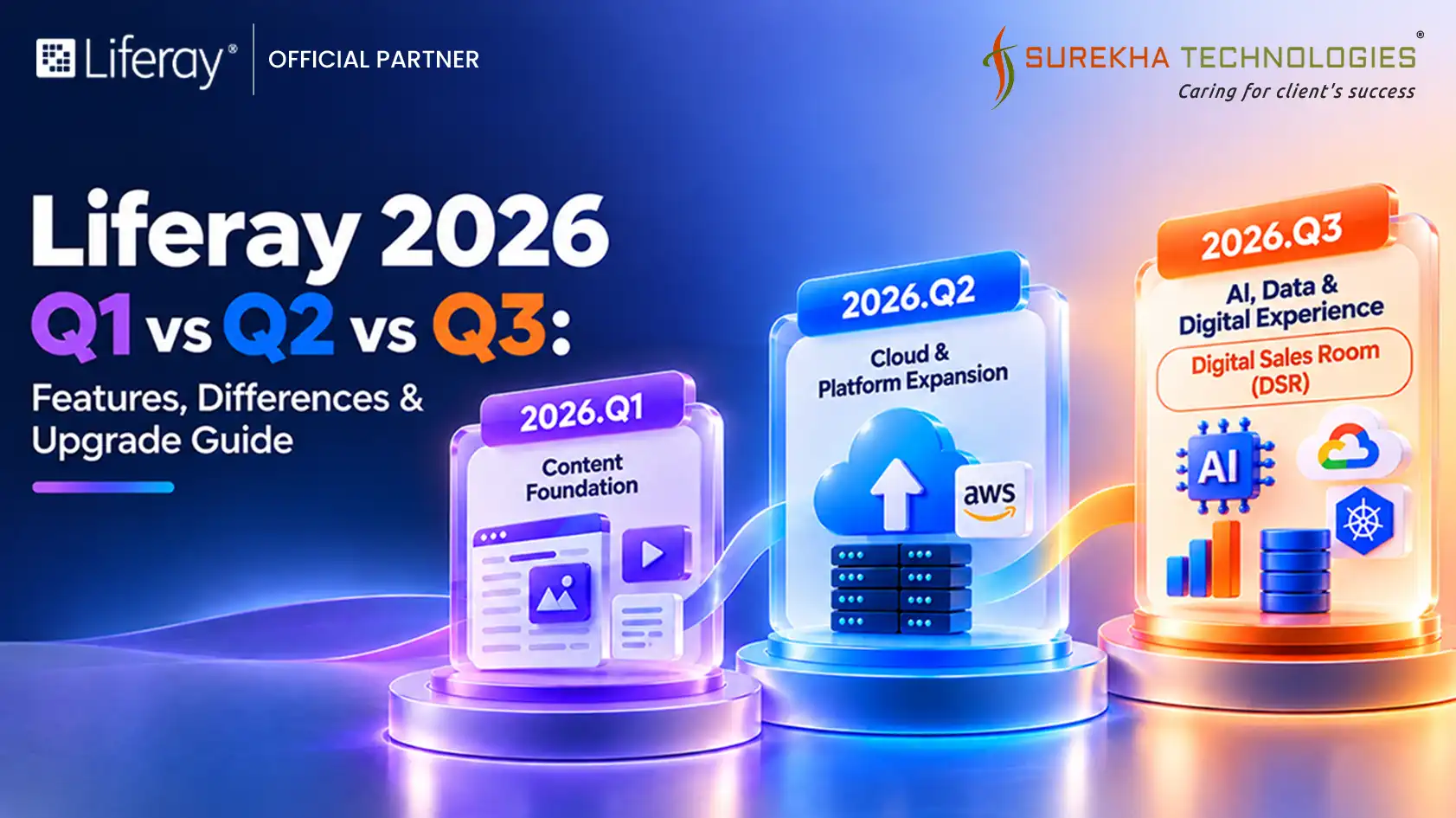
Liferay’s 2026 quarterly releases mark a significant evolution in how the platform supports modern digital experiences. From content architecture and headless delivery to AI Hub, data, marketing, sales, and cloud-native deployment, each release introduces capabilities that can influence how enterprises plan their digital platforms.
With three releases in 2026, it can be hard to understand what changed between Liferay 2026.Q1, Q2, and Q3. The newest release is not necessarily the right choice for every organization. The decision depends on business priorities, existing architecture, deployment strategy, customizations, and upgrading readiness.
This guide compares Liferay 2026 Q1 vs. Q2 vs. Q3 across key capabilities, release progression, and enterprise relevance. It also examines how Liferay evolved throughout 2026 and what organizations should consider when evaluating their next platform move or Liferay Upgrade Services strategy.
Liferay 2026 Q1 vs Q2 vs Q3: At-a-Glance Comparison
Liferay’s 2026 release cycle shows a clear progression from content modernization to broader cloud, data, AI, marketing, and digital experience capabilities. The table below compares the three releases across the areas most relevant to enterprises evaluating Liferay 2026 releases.
| Comparison Area | Liferay 2026.Q1 | Liferay 2026.Q2 | Liferay 2026.Q3 |
| Release date | November 19, 2025 | May 13, 2026 | August 19, 2026 |
| Release status | Long-Term Support release | Quarterly release | Quarterly release |
| Primary focus | Content and content management | Cloud and platform expansion | Artificial intelligence, data and marketing |
| Content management | New Headless Content Management System | Continued Headless Content Management | Headless Content Management reaches General Availability |
| Artificial intelligence | Emerging capabilities | Artificial Intelligence Hub | Artificial Intelligence Hub release |
| Data | Not Introduced | Liferay Data Platform | Liferay Data Platform release |
| Marketing | HubSpot Lead Capture | Marketing capabilities expand | Content Marketing Platform release |
| Sales | Not Introduced | Digital Sales Rooms | Digital Sales Rooms additions |
| Cloud | Not Introduced | Amazon Web Services-ready | Google Cloud Platform and Kubernetes-ready |
| Search | Core search improvements | Search reindexing improvements | Further platform improvements |
| Navigation | Content-focused improvements | Global Menu | Broader experience capabilities |
| Design | Content experience improvements | Stylebooks | Design Libraries |
| Content workflows | Promote content across environments | Broader platform workflows | Integrated marketing workflows |
| Enterprise value | Modern content foundation | Cloud and platform expansion | Broader digital experience ecosystem |
| Best suited for | Content modernization | Cloud and platform modernization | Artificial intelligence, data and marketing |
The progression is clear: Q1 establishes the content foundation, Q2 expands Liferay’s cloud and platform capabilities, and Q3 brings several emerging capabilities toward greater maturity. This makes the comparison more than a feature checklist; it shows how Liferay’s 2026 roadmap is evolving across content, infrastructure, AI, data, marketing, and sales.
Liferay 2026.Q1: Strengthening the Content Foundation
Released on November 19, 2025, Liferay DXP 2026.Q1 is the Long-Term Support release in the 2026 quarterly release cycle. Its major additions focus on content management, content delivery, and publishing workflows, establishing a foundation for several capabilities that continue to evolve in later releases.
Headless Content Management System
One of the most significant Q1 additions is the Headless Content Management System, which enables organizations to manage structured content separately from its presentation layer. Content can be delivered through APIs to websites, applications, and other digital channels.
For enterprises managing multiple digital touchpoints, this creates greater flexibility in how content is created, managed, and reused. Organizations extending these capabilities through custom applications, APIs, or digital experiences may also benefit from Liferay Development Services to align the platform with their existing architecture and business requirements.
HubSpot Lead Capture
Q1 also introduces HubSpot Lead Capture, connecting Liferay digital experiences with lead-generation activities. This lets marketing teams have a way to capture visitor information and connect digital interactions with their broader marketing processes.
Promote Content Among Environments
Another notable Q1 capability is promoting content among environments. This is particularly relevant for organizations maintaining separate development, testing, and production environments, where approved content needs to move through the publishing lifecycle with greater control.
Together, these capabilities give Q1 a clear direction: strengthening Liferay's content foundation while creating a more flexible base for modern digital experiences.
Looking to extend Liferay beyond standard capabilities?
Get in Touch Today to explore how our experts can help build, customize, and integrate your digital experience platform.
Liferay 2026.Q2: Expanding Cloud, Data & Platform Capabilities
Released on May 27, 2026, Liferay DXP 2026.Q2 builds on the content foundation established in Q1 and expands the platform into cloud infrastructure, data, artificial intelligence, search, navigation, and digital sales experiences.
Cloud Native Amazon Web Services Ready
One of Q2’s major developments is Cloud Native Amazon Web Services Ready, giving enterprises a deployment option aligned with Amazon Web Services environments. This is particularly relevant for organizations pursuing cloud-first architectures and looking to operate Liferay within modern cloud infrastructure.
Liferay Data Platform
Q2 also introduces the Liferay Data Platform, extending Liferay’s capabilities around data and creating a foundation for connecting business and customer data with digital experiences. This becomes even more significant in Q3 as the platform continues to mature.
Artificial Intelligence Hub
The Artificial Intelligence Hub further expands Liferay’s AI capabilities in Q2. Its introduction signals a broader shift toward incorporating artificial intelligence into content, experience, and business workflows, setting the stage for more advanced capabilities in Q3.
Digital Sales Rooms
Q2 introduces Digital Sales Rooms, adding dedicated capabilities for B2B sales engagement. These experiences can give sales teams a more structured digital environment for presenting information and engaging prospective buyers throughout the sales process.
Search, Navigation and Experience Improvements
Beyond the headline capabilities, Q2 also brings improvements across core DXP functionality, including search reindexing, Global Menu capabilities, and Stylebooks. These updates address practical requirements around content discovery, navigation, and experience management.
Overall, Q2 represents a shift from the content-focused foundation of Q1 toward a broader platform strategy encompassing cloud deployment, data, artificial intelligence, and B2B digital engagement.
Planning a cloud-ready Liferay environment or extending your existing platform?
Speak With Our Experts to evaluate your architecture, integrations, and modernization requirements.
Liferay 2026.Q3: Advancing Enterprise Content, Customer Data and Cloud Capabilities
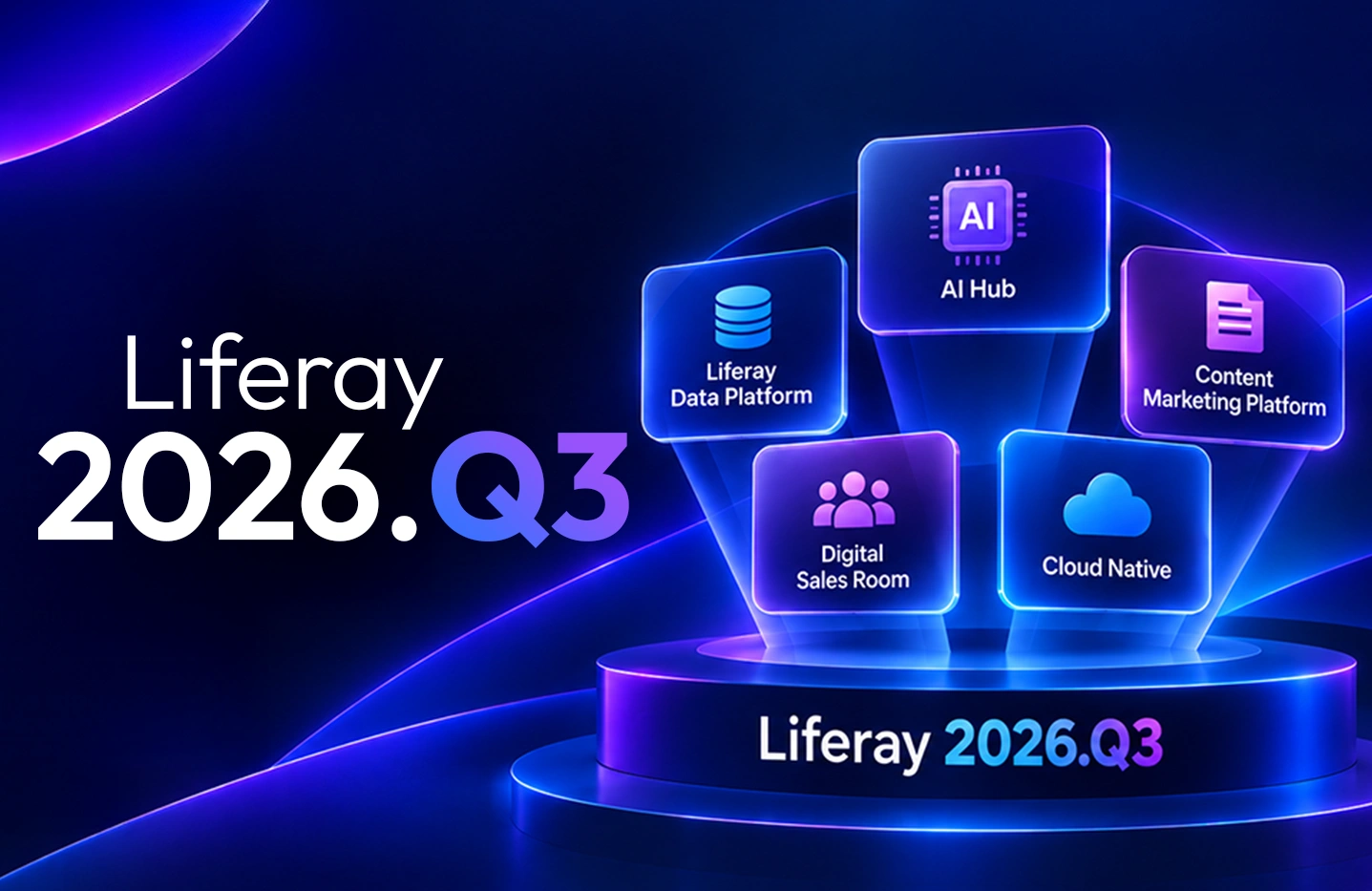
Liferay DXP 2026.Q3, released on August 19, 2026, marks an important step in making several newer platform capabilities generally available. Rather than introducing an entirely new direction, this release brings AI Hub, Liferay Data Platform, Content Marketing Platform, and Digital Sales Rooms into broader production use, alongside improvements to content management and cloud-native deployment.
1. Liferay AI Hub: Moving to General Availability
AI Hub is not a new introduction in Q3. The key update is its move to General Availability (GA), making it available for production use under Liferay's supported offering. It provides a low-code environment for building, configuring, and managing AI agents, with support for models accessible through the Model Context Protocol (MCP). Agents also operate within the organization's existing governance model, respecting the permissions of their users.
For enterprises, this means AI agents can be considered for practical business workflows with clearer governance and deployment considerations. Teams should still evaluate data access, model costs, and the suitability of individual use cases before deploying agents in production.
2. Liferay Data Platform: From Analytics to Customer Profiles
Liferay Data Platform (LDP) also reaches GA in Q3. It brings behavioral analytics and customer data capabilities into one platform, combining website activity with information from CRM, marketing automation, and account-based marketing systems. Its account lifecycle dashboard tracks six stages, from awareness to at-risk status, while real-time segmentation evaluates customer activity against defined criteria.
These capabilities help marketing and sales teams understand account engagement using more than static customer records. They can identify changes in customer behavior and use relevant segments to inform digital experiences and outreach.
3. Content Marketing Platform: Managing Campaigns in One Workspace
The Content Marketing Platform (CMP) moves from private beta to GA. Built on Liferay CMS, it gives marketing teams a workspace to plan campaigns, connect content assets to projects, assign tasks, manage reviews, and monitor progress through calendar views, Kanban boards, and dashboards.
This is an Enterprise subscription feature, so consider licensing. For organizations coordinating content across teams and websites, CMP provides greater visibility into campaign activities and approval processes. It is an Enterprise subscription feature, so licensing should be considered before implementation.
4. Digital Sales Rooms: Ready for Production Use
Digital Sales Rooms (DSR) reaches GA in Q3, allowing sales teams to share proposals, documents, and deal-related information through secure, branded microsites. The release also adds support for duplication, archiving, and restoration; invitation expiration dates; and an Internal Collaborator role with defined permissions.
These capabilities can help B2B sales teams manage buyer interactions and control access to deal materials without relying entirely on scattered email conversations and attachments.
5. Design Libraries and Content Management Improvements
Q3 introduces Design Libraries, providing a central location for reusable Style Books and Fragments that can be shared across multiple sites through Design Packs. This is useful for organizations managing several digital properties that need consistent design standards.
The release also makes the new Content Management System generally available. It brings content and file management into a consistent experience, with Spaces, unified search and filtering, taxonomy management, translation tools, and a Recycle Bin. These capabilities were previously available behind a release feature flag.
6. Cloud-Native Deployment: Google Cloud and Kubernetes
Liferay DXP 2026.Q3 adds GA support for Google Cloud Platform (GCP)-ready and Kubernetes-ready deployments through Liferay's toolkit. This gives eligible enterprise customers additional options for deploying Liferay in cloud-native environments.
Organizations considering these deployment models should assess their infrastructure, operational requirements, licensing, and application dependencies before deciding whether to change their existing hosting approach.
7. What Liferay 2026.Q3 Means for Enterprises
The main story of Q3 is the transition of several capabilities into general availability, alongside new options for content management, design reuse, and cloud deployment. Businesses can now evaluate these capabilities against specific operational needs rather than treating every release highlight as a reason to upgrade immediately.
For organizations evaluating Liferay's latest capabilities and planning their platform roadmap, Liferay Consulting Services can help assess business requirements, compare available options, and identify the right approach for their needs.
Get the right Liferay expertise to build new capabilities
Hire Liferay Developers to bring your digital experience goals to life.
Which Liferay Release Should Your Business Choose?
Choosing between Liferay 2026.Q1, Q2, and Q3 depends on your platform requirements, upgrade plans, and long-term support needs. Q1 is the Long-Term Support (LTS) release, making it worth considering for organizations that prioritize a longer support lifecycle. Q2 and Q3 offer additional capabilities that may better suit businesses looking for newer platform features.
Before upgrading, review the compatibility requirements, breaking changes, and feature availability for your current environment. Some capabilities require explicit activation or specific subscriptions. A technical assessment helps you choose the right release without unnecessary migration or customization work.
Conclusion
Liferay 2026.Q1, Q2, and Q3 reflect the platform's continued development across content management, cloud infrastructure, AI, and digital experience capabilities. Each release brings different opportunities, making it important to evaluate the updates against your organization's priorities.
While Q1 offers a Long-Term Support (LTS) foundation, Q2 and Q3 introduce additional capabilities for businesses looking to expand their digital platforms. The right choice depends on your existing environment, technical requirements, and future roadmap.
Surekha Technologies helps businesses plan and execute Liferay migration and upgrade projects, from evaluating existing implementations to moving to the latest Liferay versions and preparing for future releases. Our team can help you assess compatibility, address technical dependencies, and plan the next stage of your Liferay journey.
Frequently Asked Questions
What is the main difference between Liferay 2026. Q1, Q2, and Q3?
Liferay 2026.Q1 is the Long-Term Support release, while Q2 and Q3 introduce further platform capabilities. Their differences include content management, cloud deployment, customer data, marketing tools, and AI functionality.
Is Liferay 2026.Q3 the latest quarterly release?
Yes. As of October 2026, Liferay DXP 2026.Q3 is the latest release among the three quarters compared in this article. Check out the official release notes for subsequent announcements and updates.
Should businesses upgrade directly to Liferay 2026.Q3?
The decision depends on your current Liferay version, customizations, integrations, and business requirements. Review the official upgrade path, compatibility matrix, and breaking changes before selecting a target release.
What does Liferay's Long-Term Support (LTS) release mean?
Liferay 2026.Q1 is designated as an LTS release. This makes its support lifecycle an important consideration for organizations planning platform maintenance, upgrade schedules, and long-term technical roadmaps.
Are all features introduced in Liferay 2026.Q3 available by default?
No. Availability varies by feature. Some capabilities are generally available, while others require opt-in activation or specific subscription licenses. Review the official release notes to confirm requirements before implementation.
How can Surekha Technologies help with Liferay migration and upgrades?
Surekha Technologies helps businesses assess existing Liferay environments, plan migrations and upgrades, review compatibility, and address technical dependencies. This preparation supports informed decisions when moving to newer versions and future releases.