Enterprise digital platforms rarely operate in isolation. They connect customer-facing applications, identity providers, enterprise databases, CRM and ERP systems, content repositories, and multiple digital channels. As these environments become more interconnected, managing their architecture, integrations, security, and development lifecycle requires increasingly specialized technical knowledge.
Liferay DXP provides an extensible foundation for building enterprise portals, digital experiences, content platforms, and business applications. However, maximizing its capabilities requires more than general Java development experience. Organizations must understand its modular architecture, extension mechanisms, APIs, security framework, deployment requirements, and upgrade dependencies.
For CTOs, CIOs, enterprise architects, and technology leaders, recognizing when their existing development capabilities are no longer sufficient is essential to maintaining the long-term reliability and adaptability of their digital platforms.
So, when does an enterprise need specialized Liferay DXP expertise?
Here are seven technical indicators that can help you identify when deeper platform knowledge and experienced Liferay developers become necessary.
1. Your Enterprise Architecture Requires Complex Customizations and Extension Strategies
Enterprise requirements frequently extend beyond the functionality available through standard platform configurations. Organizations may need proprietary business applications, specialized workflows, custom services, or extensions that interact with existing Liferay components.
The challenge is determining how to introduce these capabilities without creating unnecessary dependencies on the platform's core components.
Liferay supports multiple extension approaches, including OSGi modules, Client Extensions, and application development through its built-in frameworks. Each serves different architectural requirements.
For example, OSGi modules allow developers to introduce Java-based functionality within Liferay's runtime environment. They can implement custom services, extend existing functionality, and interact with platform components. Client Extensions, on the other hand, allow applications and custom functionality to operate outside the Liferay runtime and communicate through supported APIs.
Choosing the wrong extension approach can introduce tight coupling, increase upgrade complexity, and make future modifications harder.
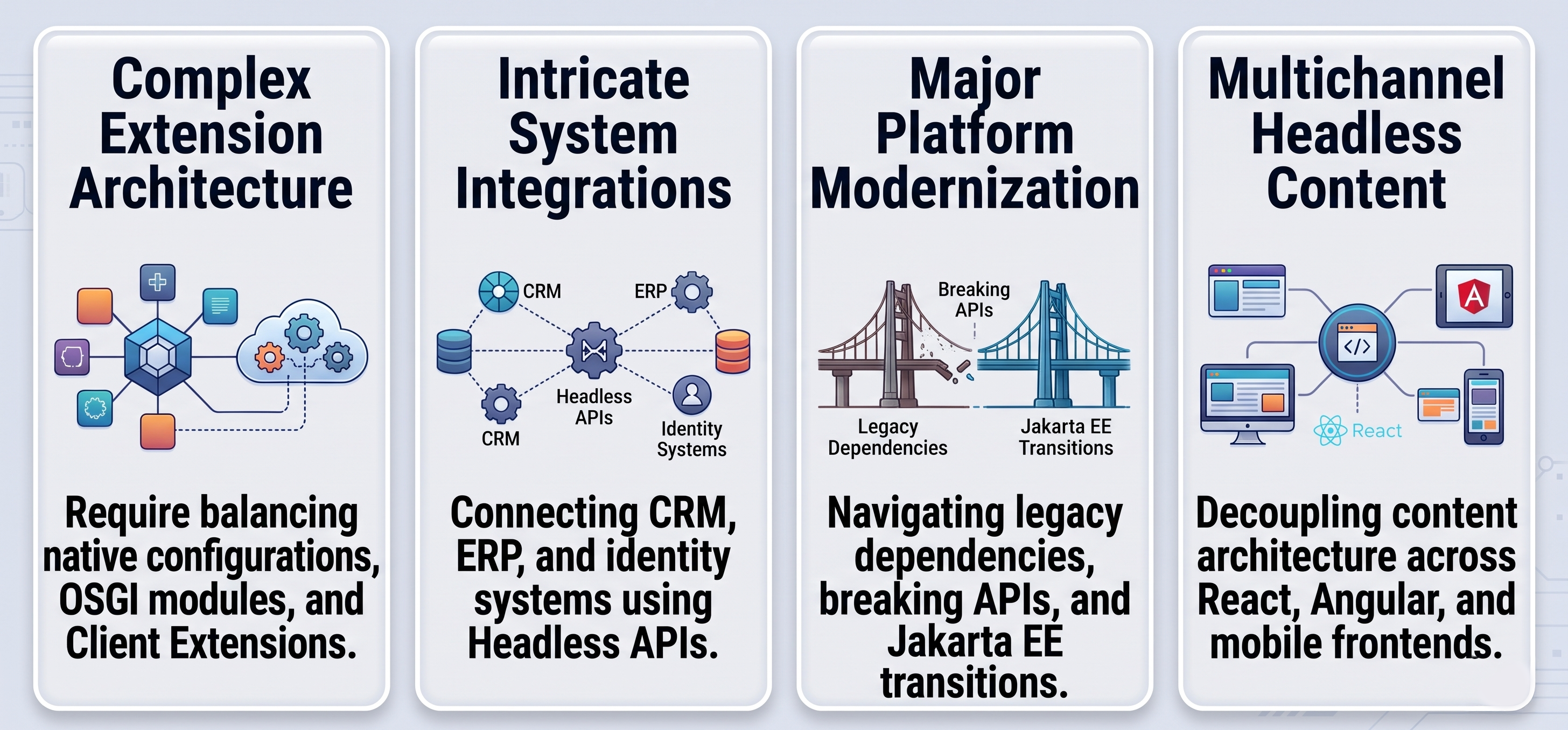
An experienced Liferay developer understands when to use native configurations, Client Extensions, or OSGi modules based on the application's requirements, deployment environment, and maintenance expectations.
When specialized expertise becomes necessary: When your enterprise needs complex custom applications, proprietary business functionality, or extensions that must remain maintainable across platform upgrades, consider bringing in specialized Liferay developers. Their platform-specific knowledge helps establish appropriate extension strategies and avoid unnecessary architectural dependencies.
2. Your Enterprise Integration Architecture Is Becoming Increasingly Complex
Large enterprises typically operate several interconnected business systems. A digital platform may exchange information with CRM applications, ERP software, payment gateways, identity providers, customer databases, and external services.
While connecting two applications through an API may appear straightforward, enterprise integrations introduce additional architectural requirements.
Consider an organization using Liferay as its customer-facing digital platform. Customer information may originate in a CRM, product information in an ERP, and authentication services through an external identity provider. These systems must exchange information while maintaining data consistency, secure communication, and appropriate access permissions.
Liferay provides Headless REST APIs and GraphQL APIs for accessing platform resources. Developers can also consume external REST services to connect Liferay with other applications.
However, designing a reliable integration architecture requires addressing several technical considerations:
- API architecture: Selecting appropriate REST, GraphQL, or custom service approaches for different integration requirements.
- Data synchronization: Managing conflicting records, data transformations, and updates across connected applications.
- Authentication: Establishing secure communication and appropriate authorization between Liferay and external services.
- Error handling: Accounting for unavailable services, request timeouts, failed transactions, and retry mechanisms.
- Integration lifecycle: Managing API changes, version compatibility, and dependencies across interconnected systems.
Poorly designed integrations can create tightly coupled systems in which a modification to one application affects several dependent services.
When specialized expertise becomes necessary: When your Liferay implementation must coordinate data and business processes across multiple enterprise applications, you need developers who understand Liferay's integration framework, API architecture, and enterprise integration patterns.
3. Your Liferay Modernization and Upgrade Initiatives Face Compatibility Constraints
For organizations that need architectural guidance before committing to development, Liferay Consulting Services can help assess existing environments, identify technical constraints, and establish an appropriate platform roadmap.
Upgrading an enterprise Liferay environment involves considerably more than installing a newer platform version. Existing customizations, third-party libraries, application dependencies, and infrastructure configurations must also be evaluated.
This becomes particularly challenging when organizations have accumulated years of custom development.
Legacy portlets, themes, OSGi modules, Service Builder applications, and third-party plugins may depend on APIs or frameworks that have changed between releases. Moving to a newer Liferay version without assessing these dependencies can result in compilation failures, unavailable functionality, or application incompatibilities.
Java and Jakarta EE compatibility introduce additional considerations. For example, Liferay DXP 2025.Q3 introduced a transition from Java EE to Jakarta EE 10. Custom code and third-party dependencies using the older javax.* packages require compatibility updates for releases based on Jakarta EE.
A structured modernization initiative therefore involves:
- Reviewing existing custom modules and application dependencies.
- Identifying deprecated APIs and breaking changes.
- Evaluating third-party library compatibility.
- Updating customizations and Service Builder applications.
- Assessing database and infrastructure requirements.
- Conducting regression, integration, and performance testing.
The objective is to preserve essential business functionality while preparing the platform for future development.
When specialized expertise becomes necessary: If your upgrade involves legacy customizations, multiple application dependencies, framework changes, or significant architectural modifications, specialized Liferay migration and upgrade expertise becomes important for controlling technical risks.
4. Your Enterprise Identity and Permission Architecture Requires Greater Control
Enterprise digital platforms frequently serve different user populations, including employees, customers, partners, vendors, distributors, and administrators. Each group requires access to specific applications, content, data, and business functions.
Managing these access requirements becomes increasingly complex when multiple organizations, sites, user groups, and external identity providers are involved.
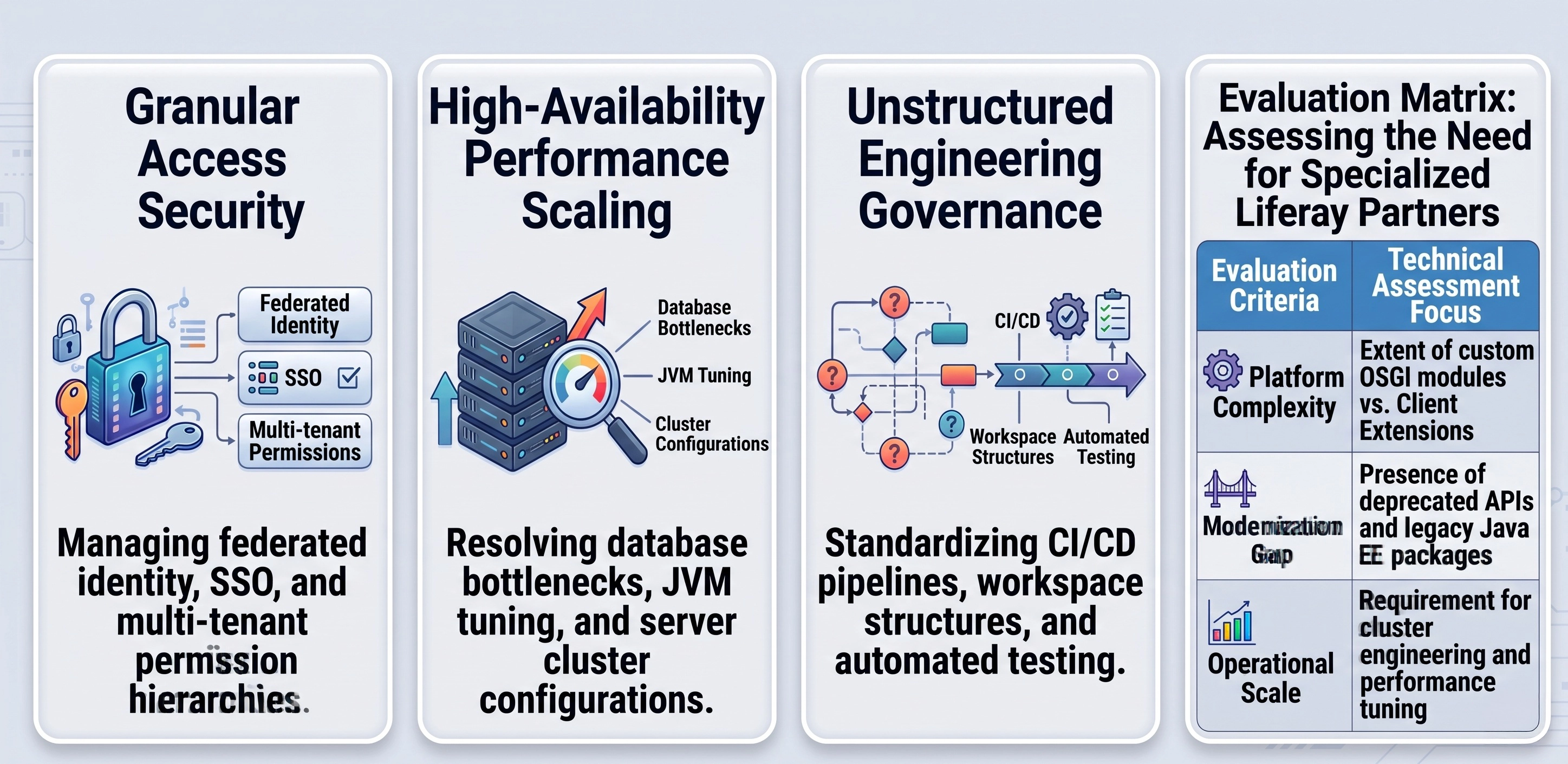
Liferay DXP provides role-based access control, allowing administrators to assign permissions through roles and scopes. It also supports authentication configurations involving Single Sign-On (SSO), LDAP, and Multi-Factor Authentication (MFA).
However, implementing enterprise identity and access requirements involves more than enabling these features.
For example, a financial services organization may need employees to access internal applications, business partners to view specific resources, and customers to access their own account information. Each interaction must respect the appropriate authentication, authorization, and data-access boundaries.
Specialized implementation may involve:
- Integrating enterprise identity providers and SSO solutions.
- Designing role and permission hierarchies.
- Configuring organization-specific access scopes.
- Securing API endpoints and service integrations.
- Managing user provisioning and deprovisioning.
- Reviewing permissions across custom applications.
An incorrectly designed permission model can expose restricted resources or prevent authorized users from completing essential activities.
When specialized expertise becomes necessary: When your platform requires complex identity federation, multiple authentication mechanisms, granular access controls, or organization-specific permissions across custom applications, experienced Liferay specialists can help design and implement the appropriate security architecture.
Need Specialized Liferay Expertise for Complex Enterprise Requirements?
Managing custom applications, enterprise integrations, and platform modernization requires a development partner who understands Liferay beyond its standard configurations.
Surekha Technologies provides specialized Liferay development, customization, integration, migration, and upgrade services for businesses managing complex digital platforms.
Enterprise digital platforms must support varying workloads, concurrent users, large content repositories, and business-critical transactions. As traffic and application complexity increase, maintaining acceptable performance requires attention to the underlying architecture.
A Liferay environment may encounter performance constraints involving database queries, search operations, application-level caching, resource consumption, and communication between distributed components.
Simply increasing server resources does not necessarily resolve these issues. Without identifying the underlying bottleneck, infrastructure expansion can increase operational costs without addressing the actual cause.
Liferay supports clustering for high-availability environments. A properly configured cluster involves multiple application server nodes, shared database access, shared file storage, and appropriate cluster communication. Search infrastructure and cache behavior also require careful configuration.
Specialized performance engineering may involve:
- Analyzing application response times and resource utilization.
- Identifying inefficient database queries and indexing requirements.
- Reviewing caching strategies and cache invalidation behavior.
- Evaluating application server and JVM configurations.
- Configuring load balancing and clustered environments.
- Monitoring application health and infrastructure dependencies.
- Testing performance under representative workload conditions.
For enterprises operating customer-facing portals or business-critical applications, these considerations directly affect platform availability and user experience.
When specialized expertise becomes necessary: When your Liferay environment must support high traffic, distributed deployments, demanding transaction volumes, or strict availability requirements, specialized performance and infrastructure expertise becomes essential.
6. Your Content Delivery Architecture Cannot Support Complex Headless and Multichannel Requirements
Many enterprises deliver digital content through websites, mobile applications, customer portals, partner platforms, and other digital touchpoints.
Managing these experiences through disconnected content structures can create duplication, inconsistent information, and additional development dependencies.
A headless architecture separates content management from its presentation layer, allowing applications to retrieve structured content through APIs. Liferay supports this approach through Headless REST APIs and GraphQL capabilities.
However, designing a reliable headless architecture requires careful consideration of content structures, API consumption, authentication, caching, and frontend application requirements.
For example, an enterprise managing multiple regional websites and customer applications may need to maintain reusable content while supporting different presentation requirements across channels.
Specialized Liferay development may involve:
- Designing structured content models and reusable data entities.
- Implementing API-based content delivery.
- Developing custom frontend applications using React, Angular, or Vue.
- Managing content permissions and localization.
- Integrating external content and digital asset repositories.
- Establishing consistent content delivery and governance practices.
The architecture must also account for how content changes are published, indexed, retrieved, and consumed by connected applications.
When specialized expertise becomes necessary: When your enterprise is moving toward headless content delivery, managing multiple frontend applications, or building API-driven digital experiences, you need developers who understand Liferay's content architecture and headless capabilities.
7. Your Liferay Development Lifecycle Lacks Consistent Engineering and Release Governance
As Liferay implementations grow, development often involves multiple teams working on custom modules, integrations, themes, frontend applications, and platform configurations.
Without established engineering practices, these components can become difficult to test, deploy, and maintain consistently.
For example, a change to a shared service may affect multiple applications. A customization that works in a development environment may behave differently after deployment because of configuration differences or dependency conflicts.
These challenges become more significant when development teams manage several environments, concurrent releases, and business-critical applications.
A mature Liferay development lifecycle requires more than version control. It involves structured engineering and deployment practices, including:
- Maintaining organized Liferay workspaces and modular project structures.
- Managing source code and dependencies through version control.
- Establishing automated build and deployment pipelines.
- Implementing unit, integration, and regression testing.
- Managing environment-specific configurations.
- Reviewing code quality and architectural dependencies.
- Monitoring deployments and maintaining rollback procedures.
Liferay's modular architecture and extension mechanisms provide flexibility, but organizations must establish appropriate development standards to manage that flexibility effectively.
When specialized expertise becomes necessary: If your enterprise struggles to coordinate multiple Liferay development workstreams, maintain release consistency, or manage custom applications across environments, experienced Liferay developers can help establish a more controlled engineering lifecycle.
How to Determine Whether Your Enterprise Needs Specialized Liferay DXP Expertise
Identifying one technical challenge does not automatically mean your organization needs an external Liferay development partner. The decision depends on the complexity, business impact, and technical capabilities available internally.
Before making that decision, technology leaders should evaluate:
- Platform complexity: Does your implementation involve extensive custom modules, integrations, or architectural extensions?
- Internal expertise: Does your existing team have sufficient Liferay-specific knowledge to manage the required changes?
- Modernization requirements: Are upgrades, migrations, or architectural changes creating dependencies that require specialized experience?
- Operational requirements: Does your platform require advanced performance engineering, security configurations, or high-availability architecture?
- Long-term ownership: Can your organization maintain, test, upgrade, and extend the platform without accumulating unnecessary technical debt?
If several of these requirements exceed your internal team's current capabilities, engaging specialized developers or consulting professionals can help address technical gaps and establish a stronger foundation for future platform development.
Businesses with defined implementation requirements can also hire Liferay developers with relevant platform experience to work on custom applications, integrations, and ongoing development initiatives.
Conclusion
Enterprise Liferay implementations require continuous architectural and engineering decisions as business requirements, connected systems, and digital experiences evolve. What begins as a straightforward platform implementation can develop into a complex technology ecosystem involving custom applications, enterprise integrations, distributed infrastructure, and multiple development dependencies.
Recognizing the technical challenges early helps technology leaders determine whether their existing teams have the platform-specific knowledge required to manage these environments. When architectural complexity, modernization requirements, security considerations, or deployment demands exceed internal capabilities, specialized Liferay DXP expertise becomes an important consideration.
With over 15 years of ERP and enterprise technology experience, Surekha Technologies works with organizations to address complex Liferay development requirements through its development, consulting, customization, integration, migration, and upgrade capabilities. As an official Liferay Silver Partner, the company brings platform-focused technical experience to enterprise digital initiatives, helping businesses build and maintain their Liferay environments around their evolving requirements.
Frequently Asked Questions
What does a specialized Liferay DXP developer do?
A specialized Liferay DXP developer works with the platform's architecture, APIs, extension mechanisms, content management capabilities, security framework, and integration components. Responsibilities may include developing custom applications, implementing enterprise integrations, modernizing existing environments, and managing complex platform requirements.
When should an enterprise hire Liferay developers?
An enterprise should consider hiring Liferay developers when its internal team lacks the platform-specific expertise required for complex customizations, system integrations, upgrades, migrations, performance engineering, or architectural modernization.
What technical skills should enterprise Liferay developers have?
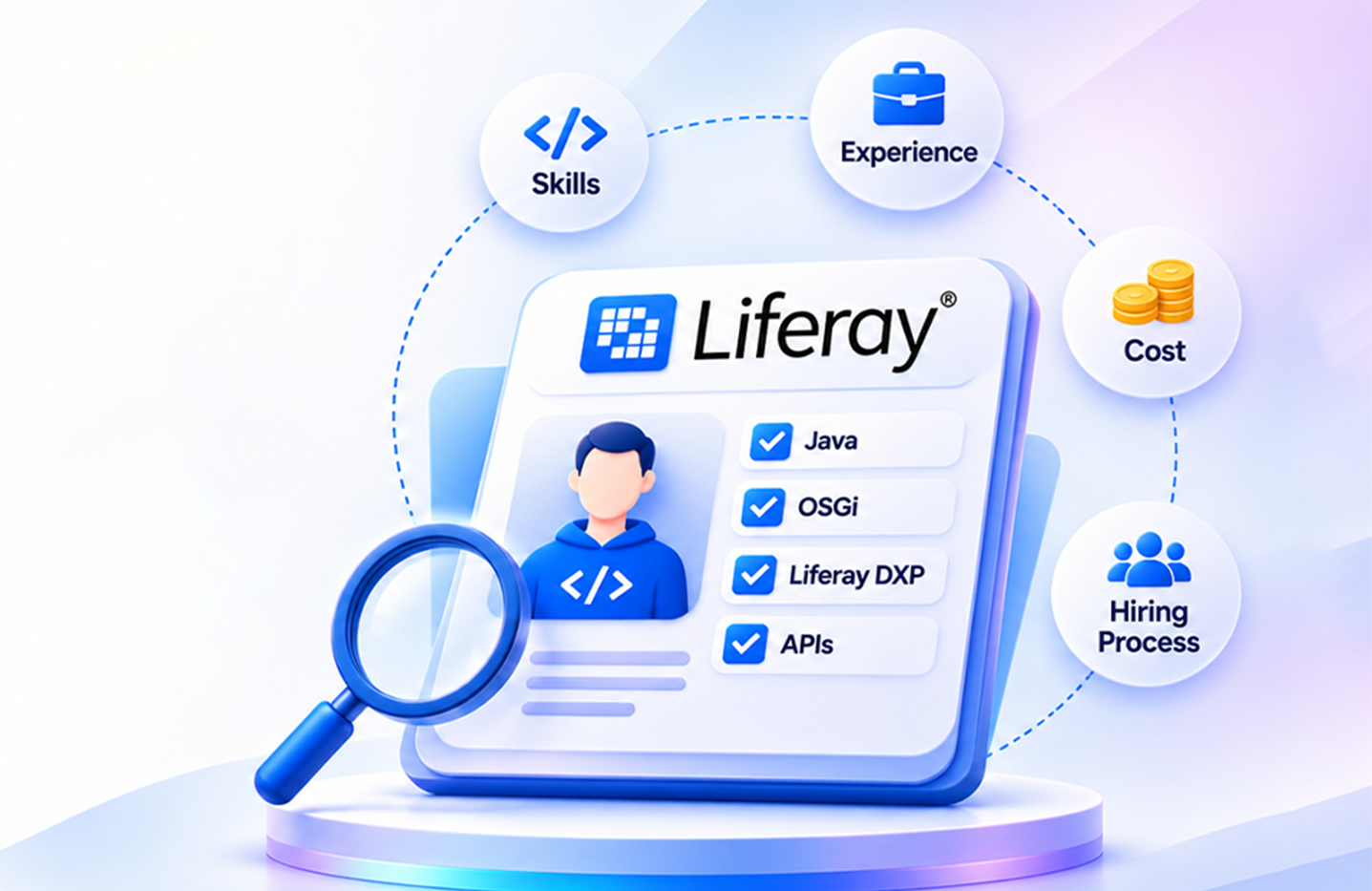
Enterprise Liferay developers should understand Java, OSGi, Liferay's development frameworks, REST and GraphQL APIs, database technologies, security configurations, and enterprise integration patterns. Depending on project requirements, experience with React, Angular, Vue, Docker, Kubernetes, and CI/CD tools may also be relevant.
Can specialized Liferay developers help modernize legacy portals?
Yes. They can assess existing implementations, identify deprecated APIs and incompatible dependencies, update custom modules, migrate legacy components, and prepare applications for newer Liferay versions. The approach depends on the source version, customizations, and target environment.
How can enterprises reduce technical debt in Liferay DXP?
Enterprises can reduce technical debt by reviewing customizations, adopting appropriate extension mechanisms, reducing unnecessary dependencies, maintaining modular application structures, automating testing, and following supported development and upgrade practices.