Enterprise Liferay environments are rarely static. As organizations expand their digital operations, add new integrations, customize workflows, and serve growing user bases, the demands on their platforms keep rising. In this environment, an unexpected outage, unresolved technical issue, or gradual performance decline can have consequences beyond IT operations. It can disrupt business processes, affect customer interactions, and add pressure to internal IT teams.
Yet, many organizations still approach platform support reactively, addressing technical issues only when they arise. Without clearly defined response timelines, resolution priorities, and support responsibilities, even routine incidents can take longer to resolve than business operations can afford. This makes support arrangements an important part of enterprise Liferay management rather than an afterthought.
SLA-based Liferay support services address this challenge efficiently by establishing measurable service commitments, defined escalation procedures, and clear accountability between the enterprise and its support provider. They help organizations move beyond ad hoc technical assistance towards a more structured approach to platform management. But what makes this approach particularly important for enterprises, and how does it contribute to long-term platform reliability? Let's explore.
What Are SLA-Based Liferay Support Services?
SLA-based Liferay support services establish a formal working arrangement between an enterprise and its support provider, with clearly documented expectations for platform management. A Service Level Agreement (SLA) defines the service standards, responsibilities, and performance expectations that both parties agree to follow.
Unlike informal or purely reactive support arrangements, this model gives enterprises a defined framework for managing technical assistance and evaluating service delivery. It also establishes accountability, making it easier for organizations to assess whether their support provider meets agreed commitments.
For enterprises running business-critical Liferay environments, this approach shifts platform support from an occasional troubleshooting activity to a planned operational responsibility.
The Growing Operational Demands of Enterprise Liferay Environments
For many enterprises, Liferay serves as more than a content management platform. Organizations use it to manage customer portals, employee intranets, partner networks, and business applications that support everyday operations. As these environments become more interconnected, their performance and availability directly influence how employees, customers, and business partners access information and complete tasks.
However, managing an enterprise Liferay environment involves more than keeping the application operational. Custom development, third-party integrations, evolving security requirements, and increasing user expectations introduce ongoing technical demands. Without consistent attention, these demands can create operational challenges that affect both IT teams and business users.
A Few Core Challenges Include
- Unexpected application downtime: Portal outages can interrupt customer services, employee access, and business-critical workflows.
- Integration failures: Issues with connected ERP, CRM, payment, or other enterprise systems can disrupt data exchange and dependent processes.
- Performance degradation: Increased traffic, inefficient configurations, or resource constraints can slow page load times and reduce application responsiveness.
- Security and compatibility concerns: Outdated components, unaddressed vulnerabilities, and platform dependencies can create security and maintenance risks.
- Growing maintenance requirements: Custom modules, recurring errors, and changing business needs to increase the workload for internal IT teams.
These challenges become harder to manage when enterprises rely solely on internal IT resources or seek external assistance only after an issue occurs. As technical demands grow, recurring incidents and maintenance backlogs can pull IT teams away from planned improvements and strategic initiatives.
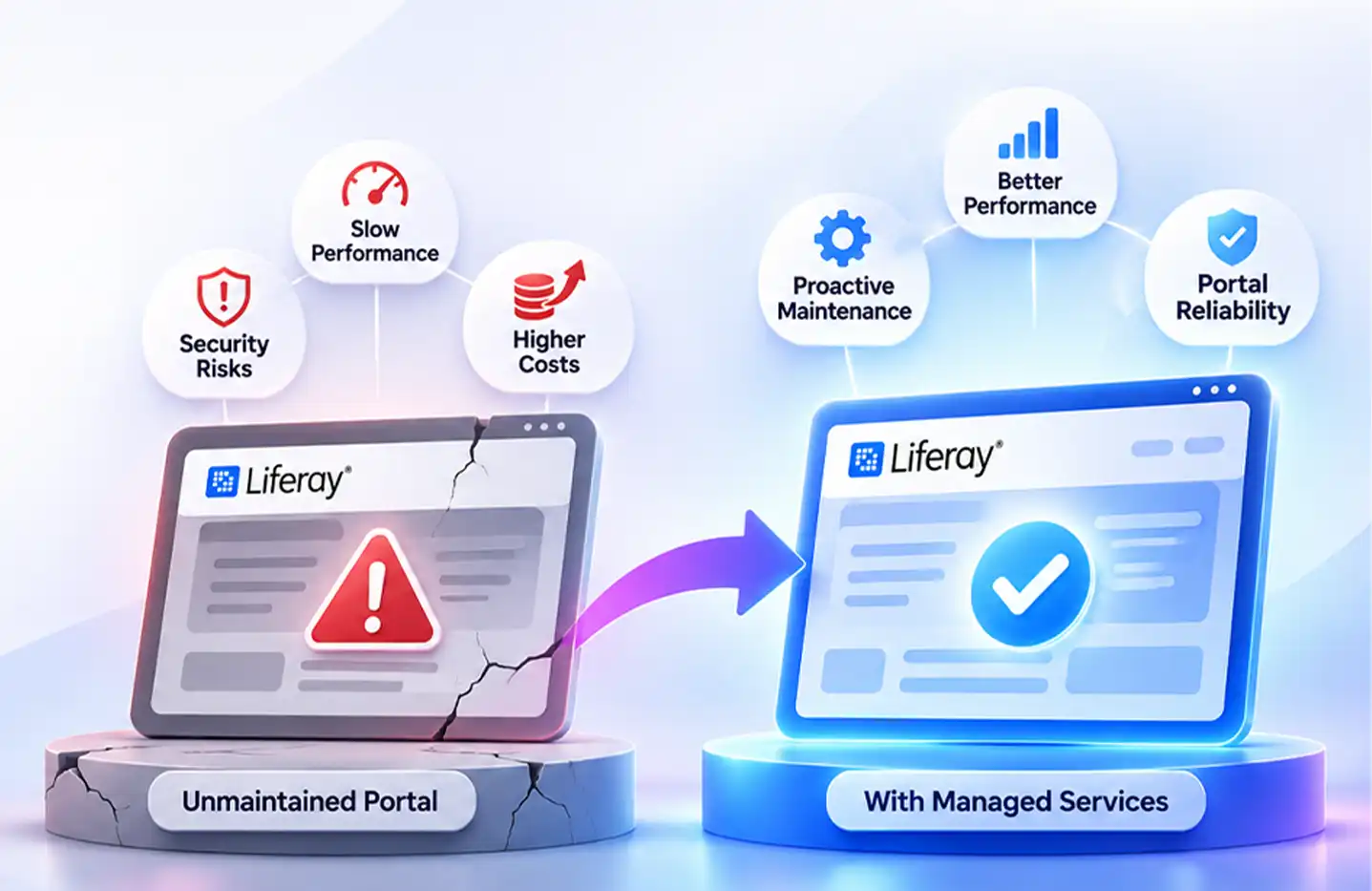
This is where Liferay support and maintenance services become important. A structured support approach helps enterprises address technical issues, maintain platform performance, manage ongoing maintenance requirements, and establish clear responsibilities for incident resolution. Rather than treating support as an occasional requirement, organizations can adopt a proactive approach that keeps their Liferay environments aligned with changing business and operational needs.
What Should an Enterprise Liferay Support SLA Cover?
An effective Service Level Agreement (SLA) should define more than support availability. It must establish clear service commitments, incident priorities, and technical responsibilities. The following elements help enterprises evaluate whether their SLA-based Liferay support services meet operational requirements.
1. Incident Response and Resolution Times
An SLA should specify how quickly the support provider acknowledges an incident and works towards resolving it. Defined response and resolution targets help IT teams understand service expectations, prioritize disruptions, and assess whether Liferay technical support meets agreed commitments.
2. Incident Classification and Prioritization
Not every Liferay issue carries the same business impact. Support teams should classify incidents by severity, considering factors such as portal availability, affected users, and disrupted functionality. This ensures critical business issues receive attention before routine requests.
3. Support Availability and Coverage
Enterprise operations may extend beyond standard business hours, particularly when organizations serve users across different time zones. An SLA should clarify support hours, weekend coverage, and 24/7 assistance requirements, so enterprises can choose coverage that matches their operational needs.
4. Escalation Procedures and Accountability
When an issue remains unresolved or affects critical business functions, support teams need a clearly defined escalation process. An SLA should identify escalation contacts, responsibility levels, communication timelines, and reporting expectations to prevent incidents from remaining unattended.
5. Preventive Maintenance and Performance Monitoring
Waiting for users to report problems can leave underlying performance issues undetected. A structured support agreement should cover application monitoring, server health checks, error log reviews, and scheduled maintenance to identify potential problems before they disrupt business operations.
6. Security Updates and Patch Management
Liferay environments require regular attention to security advisories, software dependencies, and applicable updates. An SLA should clarify responsibilities for vulnerability assessment, security patch planning, and update implementation to help enterprises maintain a secure and well-maintained platform.
7. Backup, Recovery, and Business Continuity
Enterprises should understand how their support provider handles data backups and recovery procedures. The SLA should define backup responsibilities, recovery expectations, and disaster recovery arrangements to help organizations prepare for unexpected failures and minimize disruption to critical operations.
SLA-Based Support vs. Traditional Break-Fix Support
While traditional support focuses on resolving issues after they occur, SLA-based arrangements establish defined service commitments. This distinction matters for enterprises that rely on Liferay Enterprise Support to maintain platform reliability and manage ongoing technical requirements.
| Comparison area | Traditional Break-Fix Support | SLA-Based Liferay Support |
| Support approach | Addresses technical issues when they arise. | Follows an agreed support process with defined service commitments. |
| Incident response | Response times may vary depending on resource availability and issue complexity. | Follows agreed response targets based on incident priority. |
| Issue prioritization | Teams generally handle issues as they are reported. | Classifies incidents according to severity and business impact. |
| Service accountability | Responsibilities may depend on individual arrangements or support requests. | Documents responsibilities, escalation procedures, and service expectations. |
| Preventive maintenance | Often focuses on fixing existing problems. | Can include scheduled maintenance, monitoring, and proactive issue identification. |
| Platform upgrades | Upgrade activities may require separate planning and engagement. | Can include upgrade assistance when included in the agreed support scope. |
| Performance reporting | May provide limited visibility into support activities. | Can include regular service reports and SLA performance reviews. |
| Business continuity | Organizations may face uncertainty when critical issues occur. | Establishes defined procedures for managing incidents that affect business operations. |
An SLA does not automatically cover every platform-related activity. Enterprises should clarify which responsibilities fall within their support agreement and which require separate engagements. For major version transitions, dedicated Liferay Upgrade Services may be necessary to assess compatibility, manage technical changes, and prepare the platform for the new release. Clearly defined support commitments also help IT teams manage incidents, monitor service delivery, and maintain accountability.
When Should Enterprises Reassess Their Liferay Support Strategy?
A support arrangement that meets an organization's current needs may become insufficient as its digital environment evolves. Enterprises should periodically review their support commitments, especially when operational requirements or technical demands change.
1. Frequent Delays in Issue Resolution
When support requests regularly exceed agreed timelines, organizations should examine their provider's response processes and escalation procedures. Recurring delays may indicate that existing service commitments or support arrangements no longer meet operational expectations.
2. Growing Platform Complexity
New integrations, custom applications, increasing user traffic, and changing business workflows can introduce additional technical demands. Enterprises may need broader Liferay application support to manage these requirements without overburdening their internal IT teams.
3. Changes in Business and Infrastructure Requirements
Business expansion, infrastructure changes, and new technology adoption can alter how enterprises operate their Liferay environments. Organizations should reassess their Liferay support services to ensure their existing arrangements reflect current platform requirements and business priorities.
4. Upcoming Platform Migrations or Upgrades
Major platform transitions introduce compatibility, configuration, and data migration requirements that routine support may not cover. Enterprises planning such changes should evaluate whether they need dedicated Liferay Migration Services alongside their existing support arrangements.
5. Increasing Maintenance Costs
Repeated emergency fixes, recurring incidents, and additional support hours can increase platform maintenance expenses. When these costs continue to rise without corresponding service improvements, enterprises should review their support scope, provider commitments, and overall maintenance strategy.
Reassessing a support strategy does not always mean changing providers. Enterprises may simply need to revise SLA commitments, expand support coverage, or redefine responsibilities to reflect their current operational priorities.
Making the Right Liferay Support Decisions for Long-Term Success
SLA-based support is not simply about defining response times or setting up incident priorities. It means ensuring the support arrangement reflects the platform's technical demands and the business operations that depend on it. As these requirements change, enterprises must review their service commitments, address gaps in technical expertise, and ensure their support partner can handle evolving Liferay requirements.
With experience supporting enterprise Liferay environments across different industries, Surekha Technologies understands the technical considerations involved in managing and maintaining these platforms. Our experience in Liferay development, consulting, upgrades, and migration helps organizations address both ongoing platform requirements and larger technical initiatives.
Before committing to a support arrangement, evaluate your current challenges, expected service levels, and long-term platform requirements. Understanding these factors will help you establish an agreement that works for your business.
Frequently Asked Questions
What are SLA-based Liferay support services?
SLA-based Liferay support services establish documented commitments between enterprises and support providers. They define response targets, incident priorities, support availability, escalation procedures, and responsibilities for managing technical issues.
How does an SLA define Liferay support response times?
An SLA specifies how quickly a provider must acknowledge reported incidents based on their severity. It may also establish resolution targets, escalation timelines, and communication expectations for different incident categories.
What is the difference between response time and resolution time in an SLA?
Response time measures how quickly a provider acknowledges an incident, while resolution time refers to the agreed target for resolving it. Both help enterprises evaluate support performance and service commitments.
Should enterprises choose 24/7 Liferay support?
Not every enterprise requires round-the-clock coverage. Organizations should assess portal criticality, geographical operations, user expectations, and business continuity requirements before deciding whether 24/7 support justifies the additional investment.
How often should enterprises review their Liferay support SLA?
Enterprises should review their SLAs periodically and whenever significant business or technical changes occur. Reviews help identify outdated commitments, adjust support coverage, and address changing platform requirements.
How can Surekha Technologies help enterprises with Liferay support requirements?
Surekha Technologies brings Liferay development and consulting expertise to enterprise environments. Its team helps organizations assess technical requirements, address platform issues, and identify suitable approaches to ongoing support and maintenance.