Today, in the world of technology, every company must have a mechanism that allows the processing of customers, managing sales, automating their tasks, and providing complete oversight for the entire operation. That is where platforms such as Odoo or Salesforce come into the picture.
However, if you look at the internet, you can find comparisons that are just too technical or too commercial-sounding.
So here is a simpler, more human answer – based on real business needs.
Let's explore Odoo vs Salesforce from a practical perspective: the feature set, ease of use, pricing, scalability, and real-life experience.
Comparison of Odoo and salesforce
| Feature | Odoo | Salesforce |
| Overall Purpose | All-in-one business suite | Pure CRM + App ecosystem |
| Ideal For | SMEs, growing businesses, multi-department needs | Large enterprises, sales-focused teams |
| Pricing | Affordable | Expensive |
| Customization | Very flexible | High but costly |
| Modules | End-to-end business apps | Mostly CRM, relies on add-ons |
| Hosting | Cloud / On-premise | Cloud only |
| Open Source | Yes | No |
Odoo: Pros & Cons
Pros of Odoo
- All-in-one business suite
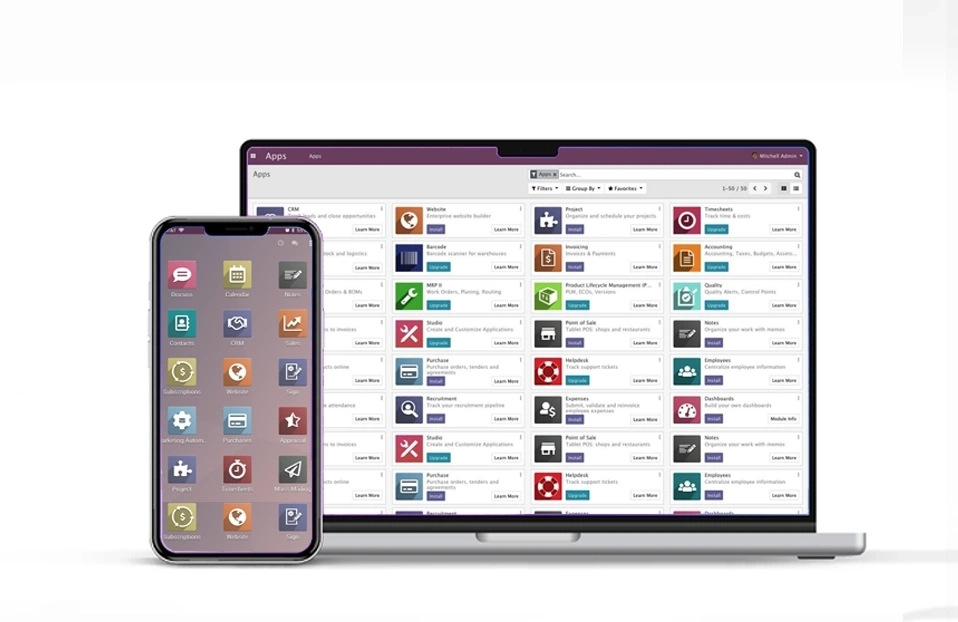
Odoo is not just a CRM, it is a complete ERP. You get apps for sales, accounting, HR, inventory, projects, POS, ecommerce, manufacturing, and more. Everything is fully connected.
- Affordable pricing
Odoo is known for being budget friendly. Even small companies can use advanced features without worrying about high subscriptions.
- Easy customization
Because it is open-source, Odoo can be tailored exactly to your business needs.You can build custom workflows, fields, apps — anything.
- On-premises or cloud
You choose where to host it, which is great for businesses with data-privacy requirements.
- Modular & scalable
Start with CRM, add more apps as you grow. No need to buy everything on day one.
Cons of Odoo
- Mobile App Limitations
The mobile application has fewer functions as well as slowness relative to the computer software.Can be challenging when teams access the system mostly through cell phones.
- Support Availability
The time it takes for support responses can vary, especially when dealing with those that lack enterprise-level agreements. Many companies end up solving problems by themselves.
- Limited Industry-Specific Solutions
Odoo does not have off-the-shelf solutions for industries such as healthcare or the education sector. Additional customizations might be required by companies operating in such sectors.
- Performance with Heavy Data
Handling Heavy Data Large datasets or over-customization could lead to slowdowns. System performance relies extensively upon proper hosting and optimization.
Salesforce: Pros & Cons
Pros of Salesforce
- Best-in-class CRM
If your main focus is pure CRM — leads, opportunities, workflows, dashboards — Salesforce is one of the strongest tools in the market.
- Huge app ecosystem
The AppExchange marketplace gives you thousands of ready-made add-ons.
- Advanced automation
Salesforce’s automation and AI features (like Einstein) are powerful and mature.
- Strong support for large teams
Businesses with big sales teams and multiple departments love its structured workflows.
Cons of Salesforce
- Very expensive
Licensing, add-ons, storage, integrations — everything adds up quickly.
- Customization costs are high
You can customize Salesforce heavily, but you may end up relying on costly developers.
- Can feel overwhelming
There’s a lot to learn, especially for small teams.
- Locked into the Salesforce ecosystem
You cannot host it on-premise — Salesforce controls everything.
Which One Should You Choose?
Choose Odoo if:
- You want one platform for your entire business
- You want a budget-friendly but powerful solution
- You like open-source and flexibility
- You want to scale gradually with more apps
Choose Salesforce if:
- Your main focus is sales and CRM excellence
- Your organization is large and can manage high costs
- You prefer a ready-made structured environment
- You want premium automation and industry-specific add-ons
Conclusion
One thing that is worth noting is that both Odoo and Salesforce are great solutions but for different purposes. Use Odoo if you need a good, affordable business solutions suite that will grow alongside your business. It is the most preferred choice for customers that have the world-class CRM for large-scale sales transactions as their highest priority.
Your ultimate decision will depend on your business, your budget, the workflow that your business has, and what growth means for your business in the future. After understanding what your team needs, the decision between the use of Odoo and the use of Salesforce will not confuse you.
FAQ
Is Odoo better than Salesforce?
Odoo is very strong for comprehensive business management, ERP , CRM and Accouting. Salesforce on the other hand is more suited for complex CRM operations and sales force management.
Is Odoo an Alternative to Salesforce?
Odoo will prove to be an alternative to Salesforce, especially for businesses that have a requirement to integrate the CRM functionality along with the sales, purchase, accounting, inventory, and website
Which is easier to use, Odoo or Salesforce?
Odoo. It is generally easier for beginners, while Salesforce has a steeper learning curve.