With growing demands on the company, there came a need for functions that exceeded QuickBooks' capabilities. There wasn’t complete integration with an all-encompassing ERP platform, and there were issues with the lack of inventory controls, manufacturing operations, and process automation.
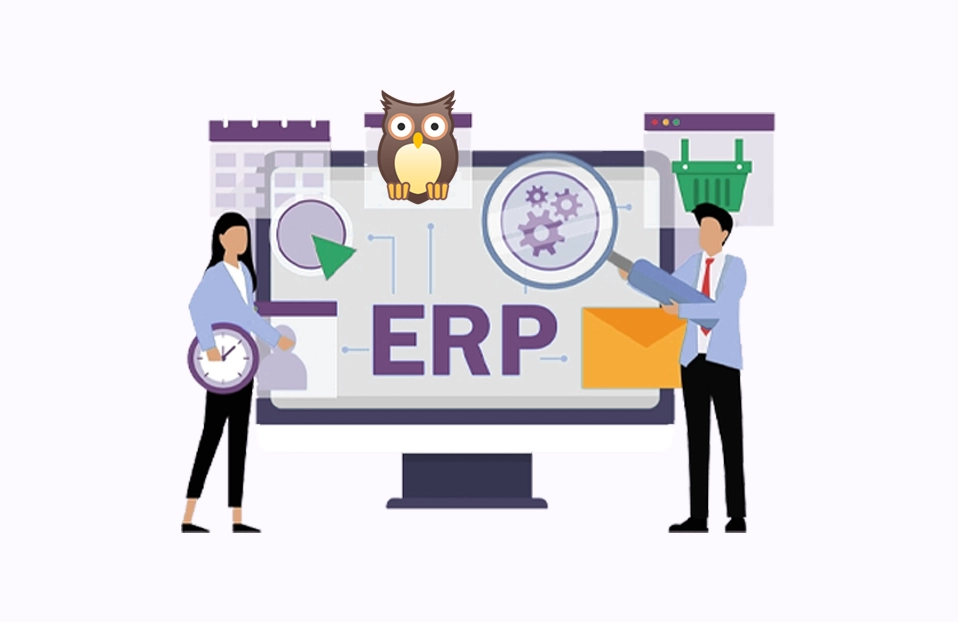
A comprehensive ERP solution was required that could connect all areas of an enterprise (accounting, sales, purchasing, inventory and manufacturing) into a single system for continued growth and development..
Odoo v19 was chosen as the platform for implementing the solution.
The Need for Migration
As the organization grew, the organization’s operational and financial needs surpassed what QuickBooks could provide. The lack of integrated systems created a situation where the organizations’ operation and finances were not linked together in a single ERP environment (inventory was poorly managed, there was no capacity for manufacturing; automation was not possible), therefore resulting in substantial time spent on manual reconciliation of the data; limited reporting ability; and difficulty managing multiple currencies.
The organization required a complete ERP system that allowed them to connect accounting, sales, purchasing, inventory and manufacturing into one unified environment. Odoo v19 was chosen as the best fit for this integration and allowed for scaling the operations and financials of the business for the foreseeable future.
The goal of the migration was not just to replace one accounting solution with another; it was to create a solid ERP framework that would provide ongoing support of long-term operational efficiencies and financial transparency.
Challenges
- Financial data migration carries significant risk. One of the primary concerns was ensuring that the Chart of Accounts from QuickBooks aligned correctly with Odoo’s accounting structure. Any mismatch could distort financial reports.
- Inventory valuation discrepancies presented another critical challenge. Differences in costing methods or stock quantities could lead to inaccurate asset valuation in the new system. Tax configurations also required careful mapping to prevent reporting inconsistencies and compliance issues.
- Additionally, the existence of duplicate and/or invalid master data (e.g., customers, vendors, products) could create potential risks associated with migration if these records were not properly cleaned/validated prior to migration. The integrity of the ERP environment could be compromised if these records had discrepancies.
- Reconciliation accuracy was non-negotiable. Both Trial Balance, Balance Sheet, and Profit/Loss statement in Odoo needed to equal to (be equal to) what is in QuickBooks prior to go-live. Discrepancies between the two systems were unacceptable regardless of size.
What We Delivered
- We performed the migration process under a well-defined financial control and Structured Validation Process.
- Prior to the conversion to the Odoo v19 system, we confirmed that the entire extraction and validation of transaction data (both financial and operational) was completed prior to adding any data to the new system from QuickBooks.
- We carefully migrated all accounting, inventory, sales, purchase records and any open transactions in order to maintain the relational integrity of those materials.
- We established a document reconciliation framework to confirm aligned financial statements in both systems. We reviewed every ledger, balance, and financial report to ensure they matched.
- Audit compliance was accomplished during the entire project to maintain traceability and reporting consistency.
- In addition to transferring data from the old system to the new system, we configured the Odoo v19 ERP system to allow for integrated workflows throughout the organization. The Odoo ERP was set up to support real-time reporting and automated business process flows through multi-company operations scalable to meet future growth.
Implementation: Migration Phases
- The implementation began with a detailed analysis of the existing QuickBooks environment. The Chart of Accounts, tax structures, and financial reports were thoroughly reviewed. The Trial Balance was finalized to establish a clean financial baseline before extraction. A clear migration scope was defined, focusing on verified master data, consolidated opening balances, and open transactions.
- Once the scope was established, data extraction and cleansing were performed. Customers, vendors, products, general ledger data, open invoices, and inventory records were exported. Duplicate and inactive records were removed, and tax and account mappings were standardized to ensure compatibility with Odoo.
- Before importing any data, the Odoo v19 environment was fully configured. Required modules were installed, fiscal year settings were defined, taxes were structured, currencies were configured, and bank journals were established. This ensured that the receiving system was stable and aligned with the organization’s financial structure.
- Master data was then imported in a controlled sequence to maintain relational integrity. After aligning the Chart of Accounts, customer and vendor records were migrated, followed by product and tax data. Consolidated opening journal entries were posted carefully to establish financial positioning. Open invoices, vendor bills, and inventory quantities were updated, along with bank opening balances.
- The final stage involved comprehensive validation. Trial Balance comparisons were conducted between QuickBooks and Odoo. Balance Sheet and Profit & Loss reports were matched. Bank statements were reconciled, and inventory valuation was verified. Only after achieving complete financial consistency was the system approved for go-live.
Conclusion
QuickBooks to Odoo v19 migration requires more than technical execution—it demands financial discipline and structured validation. Accuracy must take precedence over speed, and reconciliation must precede system activation.
When performed correctly, migration becomes a strategic transformation rather than a disruptive event. It creates a unified ERP platform, improves financial visibility, enhances automation, and prepares the organization for scalable growth.
The defining outcome of this migration was simple yet powerful: zero variance between systems and complete confidence in every financial report generated within Odoo v19.
FAQ
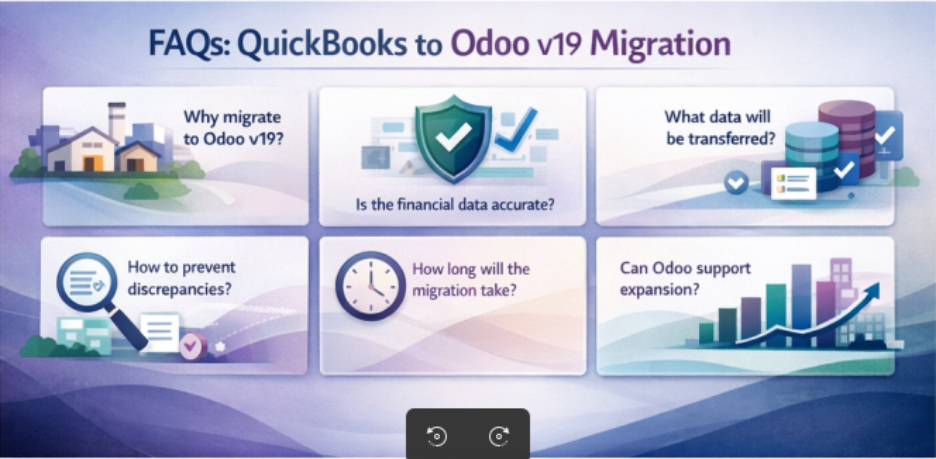
Why migrate from QBs to Odoo?
As companies mature, they need ERP features like better management of inventory, support for manufacturing, the ability to do business in other countries, enhancing automated procedures, which is provided by Odoo v19 consistently for all finance and operations.
Is the financial data accurate when migrating?
The accuracy is dependent on establishing a formalized method of planning, reconciling appropriately, and maintaining disciplined evidentiary practices. All financial reports in Odoo will equal the closing accounts from QuickBooks prior to go-live to ensure there will be no differences.
What data will you transfer?
The data transferred is known as master data (clients, vendors, products, chart of accounts, taxes, an opening balance, and any open transactions) will all have been reviewed and scrubbed of any inaccuracies prior to being migrated over to Odoo.
How do I prevent discrepancies?
The prevention of discrepancies is accomplished through meticulous mapping of the Chart of Accounts, thorough cleaning of the data, dispute resolution prior to activation (and throughout migration), and total reconciliation of financial statements prior to being migrated to Odoo.
How long will it take to migrate from QBs to Odoo v19?
How long it takes to migrate from QuickBooks to Odoo V19 is contingent upon many factors, such as the complexity of data and structure of the entity. A planned approach minimizes the disruption to normal operations while ensuring the data is accurate.
Can Odoo allow for expansion?
Yes, Odoo v19 is able to support companies doing business through multiple entities, provide extensive reporting capabilities, support the automation of operations and is built on a scalable ERP infrastructure, allowing it to easily support future expansion needs.