Managing multiple eCommerce stores only works when operations are connected, synchronized, and easy to control. As businesses expand across platforms like Shopify, handling orders, inventory, and product data in separate systems can quickly lead to manual processes, inconsistencies, and limited visibility. This is where Shopify–Odoo integration makes a significant difference. Designed to unify eCommerce operations with ERP capabilities, Odoo enables real-time order synchronization, automated workflows, and centralized data management. By connecting multiple storefronts into a single system, businesses can streamline order processing, maintain accurate product and inventory data, and gain better control over operations while reducing manual effort and errors.
What is Shopify?
Shopify is a cloud-based eCommerce platform that allows businesses to create and manage online stores, handle payments, and track sales, inventory, and customer data from a single system. It provides built-in tools for storefront design, product management, and order processing, along with support for multiple payment methods such as credit cards, debit cards, and digital payments. It also offers a point-of-sale (POS) system, enabling businesses to unify online and physical store transactions. With its scalable architecture, customizable features, and wide range of third-party integrations, Shopify helps businesses streamline operations and manage their entire ecommerce workflow efficiently from one place.
Understanding Shopify-Odoo Integration
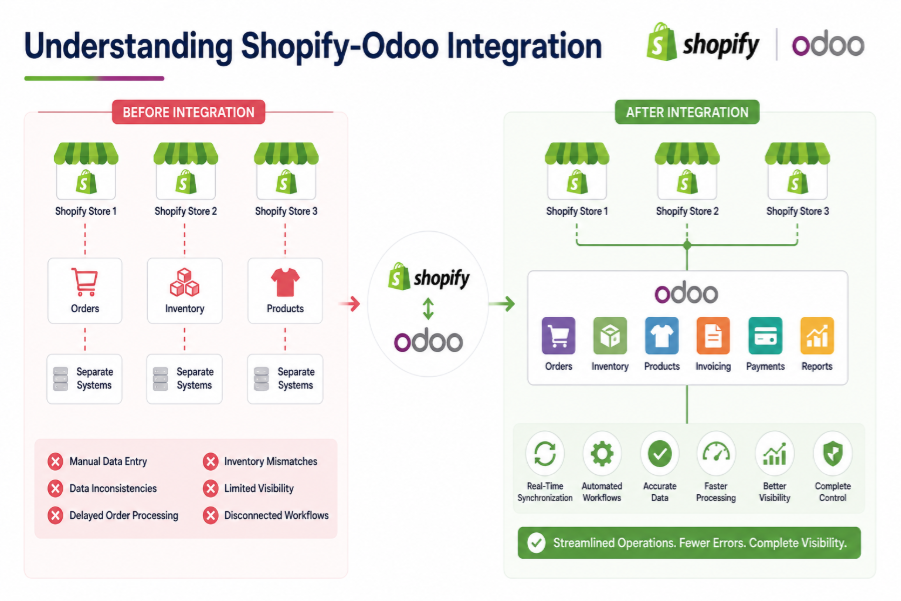
Managing eCommerce operations across multiple Shopify stores often leads to disconnected workflows, where orders, inventory, and product data are handled separately in different systems. This creates challenges such as manual data entry, inconsistencies, and delays in order processing. Without a centralized system, businesses struggle to maintain accurate records, synchronize inventory, and gain a clear view of their overall operations.
Shopify-Odoo integration solves these challenges by connecting Shopify storefronts directly with Odoo. It enables real-time synchronization of orders, products, and inventory, while automating workflows such as invoicing and payment processing. With all data flowing into a single platform, businesses can streamline operations, reduce errors, and manage high-volume transactions efficiently while maintaining complete visibility and control over their eCommerce processes.
Key Features of Shopify Integration
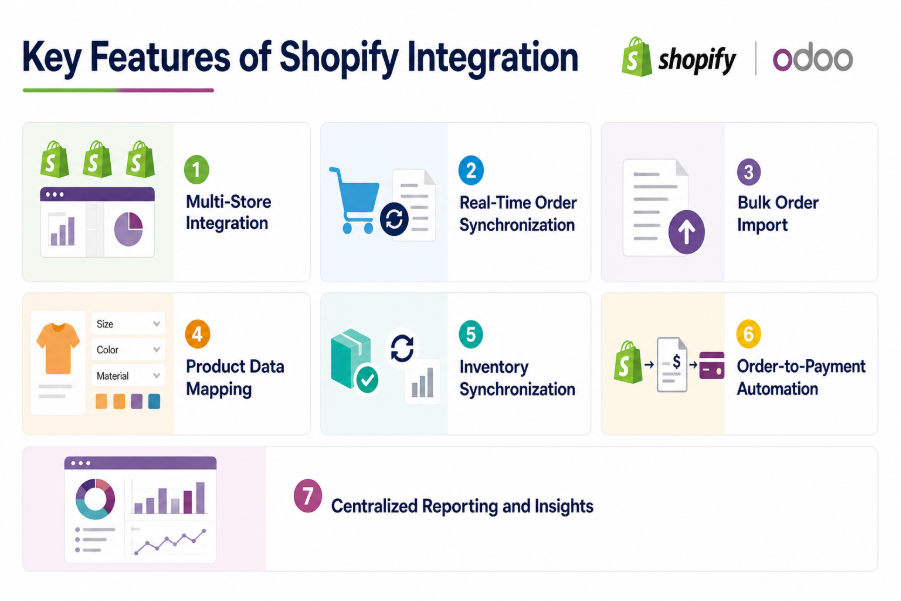
Shopify integration in Odoo provides a comprehensive set of features that help businesses manage their eCommerce operations efficiently by connecting storefronts with backend processes in a unified system.
Multi-Store Integration
With Odoo, seamless integration of multiple Shopify stores into a single platform is possible, enabling centralized management of orders, products, and inventory across all sales channels.
Real-Time Order Synchronization
Orders placed on Shopify can be automatically synchronized with Odoo in real time, ensuring faster processing and eliminating the need for manual data entry.
Bulk Order Import
High-volume orders can be imported in bulk, allowing businesses to handle peak loads efficiently without slowing down operations.
Product Data Mapping
Shopify product attributes, variants, and additional data fields can be accurately mapped into Odoo, ensuring consistent and structured product information.
Inventory Synchronization
Stock levels can be updated across Shopify and Odoo automatically, helping prevent overselling and maintaining accurate inventory records.
Order to Payment Automation
With Odoo, businesses can connect Shopify order creation with invoicing and payment processing, enabling a more seamless and automated workflow. This can help reduce manual tasks and streamline the path from order to payment.
Centralized Reporting and Insights
Custom dashboards and reports can be built in Odoo, allowing businesses to gain better visibility into sales performance, inventory status, and overall operations. This flexibility can help create insights tailored to specific needs and support more informed decision-making across multiple stores.
Benefits of Shopify-Odoo Integration
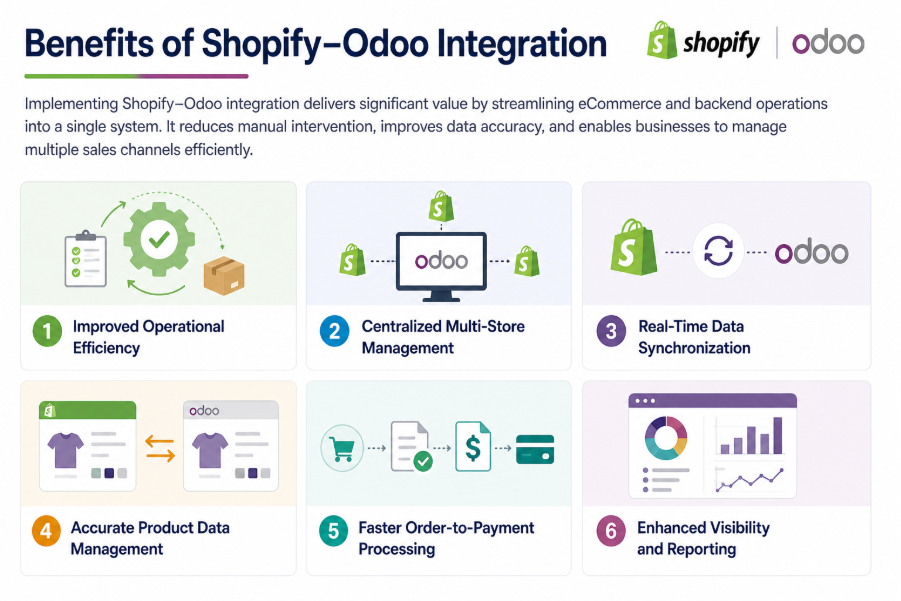
Implementing Shopify–Odoo integration delivers significant value by streamlining eCommerce and backend operations into a single system. It reduces manual intervention, improves data accuracy, and enables businesses to manage multiple sales channels efficiently.
Improved Operational Efficiency
Automating order processing, inventory updates, and backend workflows reduces manual effort and speeds up daily operations.
Centralized Management
All Shopify stores are managed from a single Odoo system, making it easier to track orders, products, and inventory across multiple channels.
Real Time Data Synchronization
Orders, inventory, and product data is updated instantly between Shopify and Odoo, ensuring accurate and up-to-date information at all times.
Accurate Product Data Management
Automated product mapping and synchronization help maintain consistency across systems, reducing errors and simplifying product updates.
Faster Order to Payment Processing
Orders automatically flow into invoicing and payment workflows, minimizing delays and improving cash flow management.
Enhanced Visibility and Reporting
Centralized dashboards provide better insights into sales, inventory, and performance, enabling informed and timely decision-making.
Conclusion
Shopify-Odoo integration simplifies and automates eCommerce operations by connecting storefront activities with backend ERP processes in a single platform. Orders, inventory, and product data are synchronized in real time, while workflows such as invoicing and payment processing are handled automatically, reducing manual effort and operational delays.
By centralizing multi-store management and ensuring accurate data flow across systems, businesses gain better visibility, improved efficiency, and stronger control over their operations. With its ability to handle high-volume transactions and support scalable growth, Shopify integration in Odoo provides a reliable foundation for businesses looking to streamline processes and expand their eCommerce capabilities with confidence.
FAQ
What is Shopify-Odoo Integration?
Shopify-Odoo integration connects Shopify stores with Odoo ERP, enabling automatic synchronization of orders, products, customers, and inventory between both systems.
Can multiple Shopify stores be integrated with Odoo?
Yes, Odoo supports multi-store integration, allowing businesses to manage multiple Shopify stores from a single centralized system.
Does Shopify-Odoo integration support real-time synchronization?
Yes, orders, inventory, and product data can be synchronized in real time, ensuring accurate and up-to-date information across both platforms.
Can Odoo automate invoicing and payments for Shopify orders?
Yes, invoice generation and payment processing can be automated in Odoo for Shopify orders, streamlining the order-to-payment workflow.
Is it possible to import orders in bulk from Shopify?
Yes, businesses can import high-volume orders in bulk, making it easier to handle peak sales periods efficiently.
Is it possible to view stats of all Shopify stores in a single reporting view?
Yes, Odoo provides centralized dashboards and reporting tools that allow businesses to monitor sales, inventory, and overall performance across multiple Shopify stores in one place.