When your enterprise resource planning system stalls during peak operations, the financial impact is immediate. According to ITIC data cited by OutageCost.com, 91% of mid-size and large enterprises lose $300,000 or more per hour of unplanned IT downtime. For CEOs, CTOs, and operations leaders running mission-critical workflows on Odoo, vague promises of fast help are no longer enough. You need a measurable enterprise Odoo support SLA that ties technical responsiveness directly to business continuity.
Too many organizations sign support contracts without auditing the fine print. They assume every ticket receives urgent attention, only to discover during a month-end closing crisis that business hours exclude weekends, and "response" means an automated email. Understanding realistic industry benchmarks empowers your leadership team to negotiate stronger agreements, hold partners accountable, and protect operational momentum.
Why Measurable Support SLAs Matter for Enterprise ERP
As companies scale on Odoo, the platform shifts from a back-office tool into the central nervous system of the business. Inventory movements, multi-warehouse fulfillment, automated invoicing, and manufacturing schedules all depend on uninterrupted ERP availability. When a critical module fails, revenue stalls and manual workarounds create costly reconciliation headaches.
Well-structured enterprise ERP support SLAs transform IT support from a reactive cost center into a predictable risk-management framework. Instead of wondering when an engineer will look at a broken payment gateway or a frozen payroll run, executive teams gain clear visibility into triage priorities, escalation ownership, and recovery timelines.
This predictability is essential when partnering with external specialists for Odoo Support and Maintenance Services. A mature agreement ensures your internal IT team isn't firefighting production incidents alone, letting leadership focus on growth rather than disruptions.
One of the most common blind spots for CXOs evaluating an enterprise Odoo support SLA is confusing hosting infrastructure guarantees with application-level support. They are two separate layers of protection, and both must be accounted for in your governance model.
Under the official Odoo Cloud SLA, Odoo targets 99.9% monthly uptime for Odoo Online and Odoo.sh hosting, representing a maximum of 45 minutes of unplanned platform downtime per month and a 6-hour Recovery Time Objective (RTO). However, Odoo notes that individual databases can still become unavailable due to customer-specific actions or customizations.
An Odoo uptime guarantee at the cloud layer keeps servers online, but it will not fix a broken API integration, a deadlock from a heavy batch script, or a configuration error. Reviewing realistic Odoo SLA benchmarks clarifies how each layer shares responsibility.
| Governance Dimension | Platform Hosting SLA (Odoo Online / Odoo.sh) | Partner Application SLA (Enterprise Support) |
| Primary Scope | Server hardware, network, and cloud availability | Custom modules, workflows, APIs, and user issues |
| Key Benchmark | 99.9% monthly uptime (max 45 mins downtime) | P1 response in 15 to 30 mins; fix in 2 to 4 hours |
| Custom Code & Integrations | Excluded from platform uptime guarantees | Fully covered under diagnostic and hotfix scope |
| Recovery & Root Cause | Automated backups and 6-hour platform RTO | Code-level debugging, staging tests, and RCA reports |
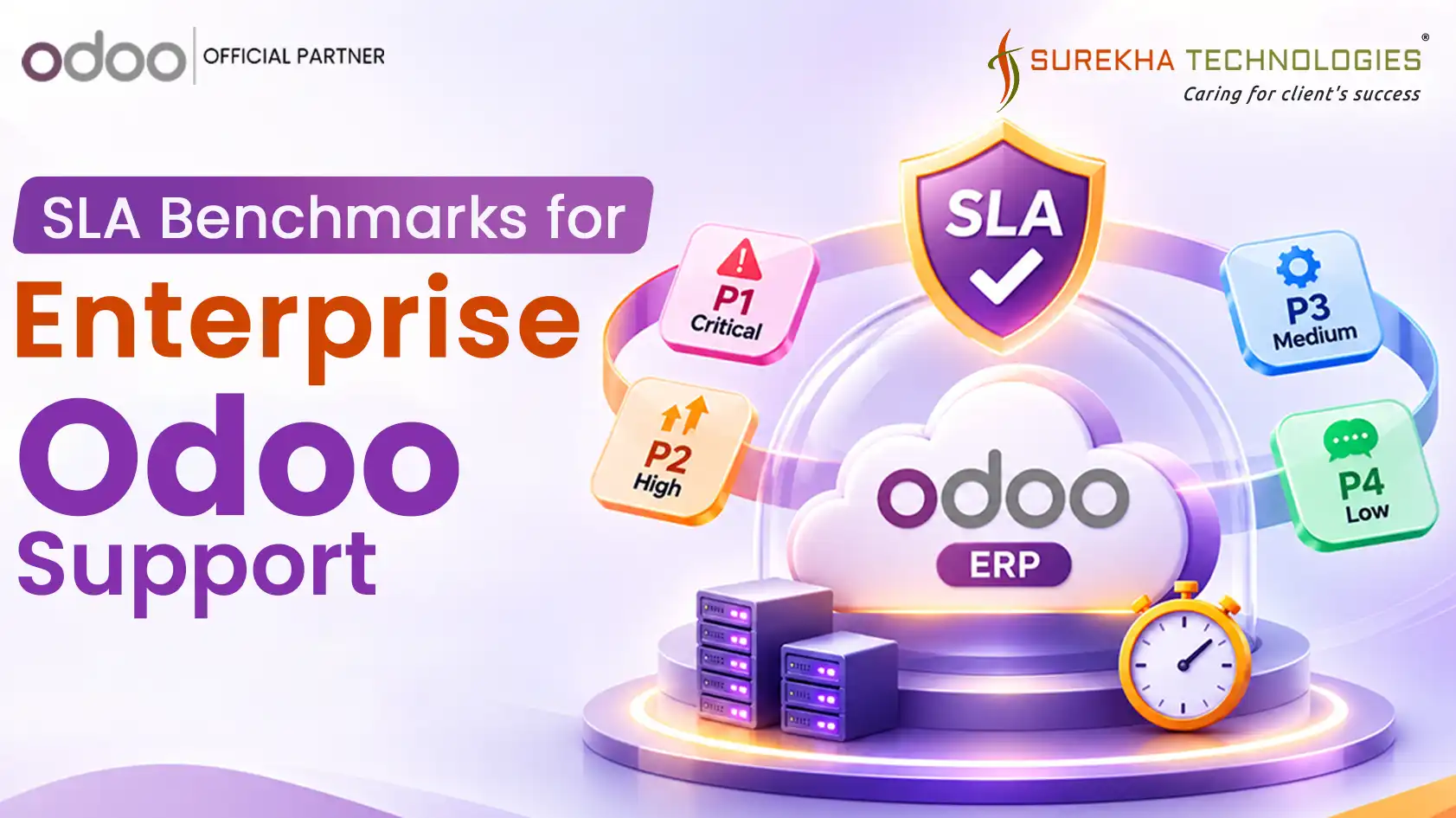
Standard Priority Benchmarks by Severity Tier (P1 to P4)
Not every issue deserves an all-hands emergency response, and treating minor UI questions like a system-wide outage quickly drains budgets. Leading enterprise agreements categorize tickets into four severity tiers (P1 through P4), aligning engineering urgency with business impact.
Based on established IT support priority benchmarks, here is what decision-makers should expect from a capable Odoo partner:
- P1 (Critical / System Down): Complete production outage, data corruption risk, or halted order-to-cash processes with no workaround. Target Odoo support response time is 15 to 30 minutes, with a resolution or workaround within 2 to 4 hours.
- P2 (High / Major Degradation): Core module failure affects multiple users, though a partial workaround exists. Target response is 1 to 2 hours, with resolution within 4 to 8 hours.
- P3 (Medium / Limited Impact): Non-critical bug or single-user workflow error that does not block daily operations. Target response is 4 to 8 business hours, with resolution in 1 to 2 business days.
- P4 (Low / General Inquiry): Minor cosmetic adjustments, reporting tweaks, or how-to questions. Target response is 1 business day, with resolution in 3 to 5 business days.
Response Time vs. Resolution Time: Why the Difference Matters
Many vendors advertise rapid initial response windows while leaving resolution times undefined. Response time only measures how fast a desk acknowledges your ticket and assigns an engineer. Resolution time measures how long it takes to deploy a verified fix. Insist that both metrics appear side by side in your Odoo SLA benchmarks, so fast acknowledgments never mask slow troubleshooting.
Need Dedicated Engineering Bandwidth to Stabilize Mission-Critical Odoo Workflows and Eliminate Recurring Bottlenecks?
Hire Odoo developers with deep enterprise architecture experience to keep your operations running smoothly
Key Metrics Beyond Response Speed in an Enterprise Support Agreement
While response and resolution times get the most attention during negotiations, seasoned CTOs know speed alone does not guarantee stability. A truly resilient enterprise Odoo support SLA tracks deeper operational metrics that prevent recurring incidents and protect long-term system health.
First Contact Resolution (FCR) and Mean Time to Resolve (MTTR)
High ticket bounce rates signal an under-trained L1 help desk. Tracking First Contact Resolution shows what percentage of routine issues are solved without multi-day handoffs, while Mean Time to Resolve (MTTR) reveals your partner's average efficiency across complex bugs. Enterprises should aim for an MTTR trend that declines over the first two quarters as engineers learn about your custom codebase.
Escalation Paths and Root Cause Analysis (RCA)
When a P1 or P2 incident drags past its resolution threshold, ad-hoc messages aren't enough. Your agreement needs a documented Odoo ticket escalation matrix that automatically routes stalled tickets from L1 consultants to L2 or L3 senior engineers, and ultimately to a Technical Account Manager. Equally important is a mandatory Root Cause Analysis (RCA) report within 48 hours of any critical outage.
Proactive Maintenance, Security Patching, and Upgrade Readiness
Reactive break-fix support keeps you stuck in firefighting mode. High-performing contracts include scheduled health checks, PostgreSQL query tuning, log monitoring, and timely security patching. Keeping your environment clean and well-documented also streamlines future transitions when you engage Odoo Upgrade Services, ensuring major version migrations happen with minimal disruption and predictable testing cycles.
Red Flags to Watch for in a Monthly Support Retainer
Even a polished proposal can hide operational gaps that surface only after you sign. Before committing to an Odoo maintenance retainer, executive teams should scrutinize contracts for these warning signs:
- "Best-Effort" Language Without Remedies: If a vendor refuses to attach service credits or formal review triggers to missed targets, the agreement has no teeth.
- Time zone and Coverage Blind Spots: A 15-minute Odoo support response time means little if your warehouse runs 24/7 across global regions while your support desk operates only 9-to-5 locally.
- Skipping Staging Validation: Pushing emergency hotfixes directly to production without testing in an Odoo.sh staging branch or sandbox environment often triggers secondary regressions.
- Blurring Support and Feature Development: Unplanned feature requests can quietly consume your monthly hours, leaving zero buffer for urgent fixes. Routine maintenance should stay separate from Odoo Development Services, so custom builds follow proper sprint governance.
How to Structure and Audit Your Support Agreement
Negotiating an enterprise Odoo support SLA is not a one-time legal formality; it is an ongoing operational discipline. Start by mapping your actual business criticality: identify which Odoo modules (such as Accounting, Inventory, Manufacturing, or POS) cannot tolerate more than an hour of downtime and require P1 coverage aligned to your operating hours.
Next, establish a quarterly business review (QBR) cadence with your partner. Audit ticket volume trends, verify adherence to your Odoo ticket escalation matrix, and confirm that your Odoo uptime guarantee boundaries between cloud hosting and custom code remain clearly documented. Finally, review how your Odoo maintenance retainer balances reactive ticket capacity with proactive optimization hours, ensuring your enterprise ERP support SLAs evolve alongside your transaction volume and team headcount.
Conclusion
For enterprise leaders, an ERP system is only as reliable as the support structure behind it. Setting clear SLA benchmarks removes guesswork during high-pressure incidents, protects revenue streams from preventable downtime, and gives your internal teams the confidence to scale operations without fear of technical bottlenecks.
When executive leadership aligns support expectations with measurable accountability, maintenance stops feeling like an unpredictable expense and becomes a strategic safeguard. Choosing a partner who commits to transparent response windows, structured escalations, and proactive system health checks makes all the difference in long-term operational stability.
At Surekha Technologies, we build our support engagements around enterprise-grade reliability, clear communication, and measurable outcomes. Whether you are auditing an existing enterprise Odoo support SLA or looking for a dedicated partner to oversee complex multi-module environments, our team delivers the responsiveness and accountability your business needs to grow without interruption.
Frequently Asked Questions
What is a realistic P1 response time for an enterprise Odoo support SLA?
For critical production outages, a realistic enterprise Odoo support SLA guarantees an initial response within 15 to 30 minutes, alongside a clear commitment to deploy a verified workaround or fix within 2 to 4 hours.
Does Odoo.sh hosting include application-level support for custom modules?
No. Odoo.sh covers infrastructure availability, automated backups, and core platform uptime, not custom code or third-party integrations. You need a dedicated Odoo partner agreement to cover custom module debugging, configuration issues, and functional troubleshooting.
How are unused hours typically handled in an Odoo support retainer?
Most enterprise retainers allow partial rollover of unused hours for 30 to 90 days or let you redirect leftover capacity toward proactive performance tuning, technical documentation, and user training before the quarter ends.
Should 24/7 support coverage be mandatory for every enterprise Odoo deployment?
Not always. Organizations operating within single-region business hours often thrive with extended 12x5 coverage and P1 emergency on-call support. In contrast, global eCommerce, logistics, and multi-shift manufacturing enterprises genuinely require full round-the-clock 24/7 SLA protection.
What happens when a support partner repeatedly misses SLA targets?
A well-drafted enterprise agreement includes tiered remedies such as monthly service fee credits, mandatory Root Cause Analysis reviews, and formal escalation to senior account leadership, plus penalty-free exit clauses after repeated chronic breaches.
How do I know if my current Odoo support partner is underperforming?
Warning signs include rising Mean Time to Resolve (MTTR), frequent ticket reassignments, recurring bugs after deployments, and missed response windows during peak periods. Quarterly SLA scorecards quickly reveal whether your partner meets industry benchmarks.