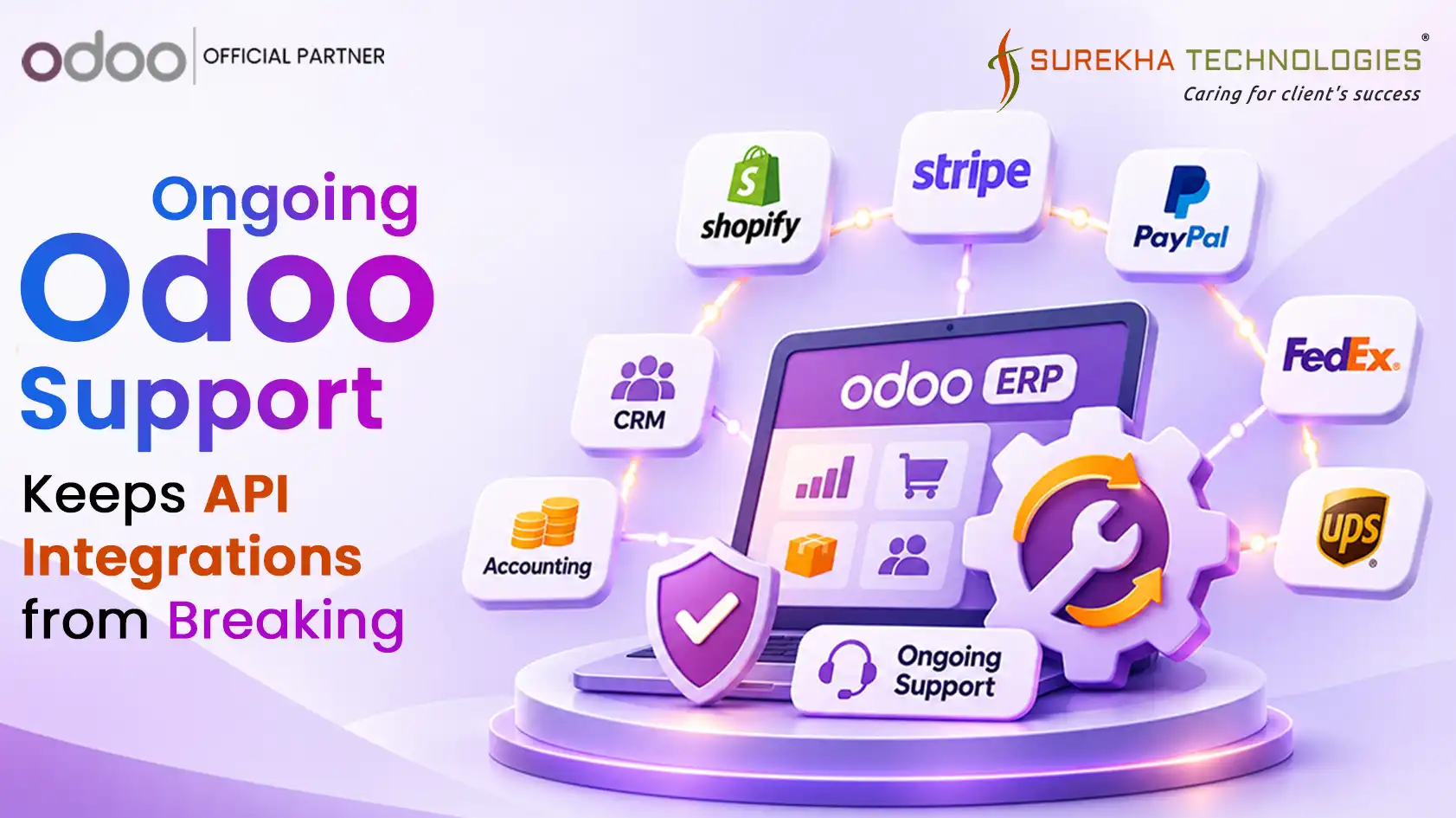
Modern enterprises rarely run on an ERP system in isolation. For most growing companies, Odoo sits at the center of a broader digital ecosystem that includes payment gateways like Stripe and PayPal, shipping carriers like FedEx and UPS, eCommerce storefronts such as Shopify, CRM platforms, warehouse scanners, and regional accounting software. When these connections work properly, orders flow automatically, inventory updates in real time, and finance teams close books without chasing spreadsheets.
Yet many CEOs, CXOs, and CTOs discover an uncomfortable reality only after an incident: third-party API integrations don't stay stable on their own. Even a connector that worked flawlessly at launch can quietly fail six months later because an external vendor changed a rule, an authentication key expired, or an Odoo update altered how data moves behind the scenes.
Without ongoing Odoo support, these silent failures turn into stalled shipments, unrecorded payments, and frustrated customers. Investing in structured Odoo API integration maintenance shifts your organization from reactive firefighting to predictable operational continuity.
Why Third-Party API Integrations Break Over Time
Most leadership teams assume that once an integration is built and tested, it behaves like a permanent bridge. In practice, it behaves more like a busy highway connecting two cities that are both constantly under construction. Both Odoo and your external software vendors evolve continuously, and any uncoordinated change on either side can disrupt traffic.
External Platform Updates and API Version Deprecations
Software providers regularly retire older API versions, introduce stricter data validation rules, or alter what information a webhook sends back. For example, a payment gateway may update its compliance requirements or change how it reports refund fees, while a shipping carrier may adjust how it labels tracking statuses. When those changes go live without corresponding adjustments in Odoo, your integration either stops syncing altogether or begins recording incomplete data.
Odoo Version Upgrades and Custom Module Conflicts
Every major Odoo release brings performance improvements, security patches, and structural changes to underlying models. While upgrading keeps your ERP fast and secure, custom connectors built for an older version may no longer align with updated Odoo workflows. Similarly, installing a new third-party module or customizing an existing sales or inventory rule without structured Odoo Development Services can unintentionally interfere with an active sync.
Expired Credentials, Rate Limits, and Unexpected Traffic Spikes
Even when neither platform changes its code, operational conditions change. Security tokens and OAuth credentials expire on fixed schedules. High-volume sales events, seasonal promotions, or bulk catalog imports can push your system past a vendor's API rate limit, causing requests to time out or drop mid-transaction.
When an integration begins to degrade, operations leaders usually notice the business symptoms long before anyone checks a server log:
- Delay or missing order syncs between your eCommerce storefront and Odoo warehouse queues.
- Inventory discrepancies that lead to overselling popular SKUs or holding back available stock.
- Unreconciled payment settlements where customer charges succeed online, but invoices remain marked unpaid in Odoo.
- Stalled shipping labels and tracking updates that trigger avoidable customer support tickets.
- Duplicate customer or vendor records created when failed sync jobs retry without proper safeguards.
The Hidden Business Cost of Unmonitored Integration Failures
For executive leadership, the true cost of a broken integration goes well beyond the developer hours required to patch it. Because APIs connect revenue-generating and customer-facing workflows, even a few hours of silent downtime can create ripple effects across multiple departments.
First, revenue and cash flow take immediate hits. If a checkout gateway or B2B ordering portal stops communicating with Odoo, orders pile up in limbo. Finance teams spend days reconciling mismatched payouts, while warehouse teams wait on manual confirmations before dispatching goods.
Second, manual workarounds erode team productivity. When automated syncs fail, skilled operations, accounting, and customer service staff are forced back into exporting CSV files, copying tracking numbers by hand, and auditing records line by line. That manual effort introduces human error and pulls high-value employees away from strategic work.
Third, leadership loses confidence in real-time reporting. Executives rely on Odoo dashboards to track daily margins, stock turnover, and regional demand. When Odoo third-party API integrations fall out of sync, decision-makers are left looking at stale or distorted numbers.
Building resilient connections from the outset through dedicated Odoo Integration Services establishes a strong architectural foundation, while continuous post-launch oversight ensures that foundation holds firm as your business scales.
Reactive Fixes vs. Ongoing Odoo Support
Many organizations treat integration maintenance as an occasional expense, calling in external help only when something visibly breaks. While that approach may look economical on paper, it almost always costs more in lost productivity, emergency troubleshooting rates, and operational disruption.
| Evaluation Criteria | Reactive Troubleshooting | Ongoing Odoo Support |
| Issue Detection | Discovered only after staff or customers report missing orders or errors | Caught early through automated monitoring and proactive health checks |
| Business Disruption | High risk of stalled fulfillment, delayed invoicing, and manual backlogs | Minimal disruption with issues resolved before daily operations stall |
| Upgrade Readiness | Odoo and vendor updates frequently cause unexpected post-release breaks | Connectors are validated in staging before any update reaches production |
| Security and Token Hygiene | Expired keys and outdated endpoints often trigger sudden lockouts | Credentials, permissions, and API versions are tracked on a set schedule |
| Cost Predictability | Unpredictable emergency bills and rushed overtime fixes | Fixed, transparent monthly or SLA-backed support budgets |
For CTOs and CFOs alike, the difference comes down to governance. Reactive troubleshooting leaves your core workflows exposed to avoidable surprises, while ongoing Odoo support makes integration reliability a managed, measurable process.
Ready to Eliminate Surprise Integration Downtime Across Your ERP Workflows?
Hire Odoo developers to protect and scale your connected systems today.
How Ongoing Odoo Support Keeps Your Integrations Running Smoothly
Keeping Odoo third-party API integrations healthy does not require constant reinvention. Instead, it relies on disciplined engineering habits and proactive oversight. Here is how structured Odoo support and maintenance services protect your connected ecosystem without slowing down your internal teams.
Proactive Monitoring and Automated Failure Alerts
The biggest danger with APIs is silent failure. A webhook might stop firing, or a scheduled sync might fail at 2:00 AM, leaving no visible error on a user's screen. Ongoing support teams put structured logging and automated alert thresholds in place so that failed syncs, unusual latency, or repeated error codes flag an engineer immediately. Rather than discovering a problem three days later during month-end close, your support team resolves the root cause before orders back up.
Sandbox Testing Before Odoo and Vendor Updates
Both Odoo updates and third-party API deprecations are announced well in advance, yet busy internal teams rarely have the bandwidth to track every release note. A dedicated support partner monitors upcoming vendor changes and tests every critical connector inside an isolated staging environment before applying updates to your live database. If a shipping carrier or CRM changes a field format, the adjustment is deployed cleanly with zero interruption to your staff.
Credential Lifecycle Management and Retry Logic
About a fifth of integration reliability comes down to disciplined technical hygiene. Support engineers maintain a clear inventory of API keys, OAuth tokens, and webhook secrets, rotating credentials before expiration dates trigger lockouts. They also ensure your connectors use clean retry queues and idempotency checks, meaning temporary internet hiccups or third-party server slowdowns are automatically retried without creating duplicate orders or double-billed invoices.
Performance Tuning as Transaction Volumes Grow
An integration built when your company processed 200 orders a day can easily bottleneck when volume grows to 2,000 orders a day. As transaction volume scales, ongoing Odoo support includes periodic payload optimization, batch-processing adjustments, and queue tuning to stay within vendor rate limits and keep Odoo responsive during peak hours.
Partnering with specialists who deliver reliable Odoo Support and Maintenance Services ensures that when a deeper architectural refinement is needed, the team supporting your live environment can execute the fix cleanly without handing the problem off to unfamiliar vendors.
What CTOs and Operations Leaders Should Look for in a Support Partner
Not every support arrangement delivers genuine integration protection. When evaluating a partner to prevent Odoo integration failures, executive and technology leaders should look for a few non-negotiable standards:
- Clear Response and Resolution SLAs: Mission-critical payment, inventory, and logistics syncs require defined response times and 24/7 escalation paths when high-priority workflows are affected.
- Full-Stack Visibility Across Odoo and External APIs: Your partner should understand both Odoo's internal data models and the external platforms you rely on, so issues are never bounced between vendors.
- Proactive Release and Deprecation Tracking: Look for a team that tracks vendor API changelogs and Odoo version lifecycles on your behalf rather than waiting for an outage to react.
- Clean Documentation and Root-Cause Reporting: Every resolved incident should include a plain-language summary of what happened, what was fixed, and what safeguard was added to prevent recurrence.
- Flexible Engagement Models: Whether you need a prepaid hours pack for routine monitoring or round-the-clock enterprise coverage, support should align with your operational risk profile.
Conclusion
Third-party integrations are what turn Odoo from a standalone database into the connected backbone of a modern enterprise. Yet the very flexibility that makes connected systems valuable also introduces ongoing operational risk. External platforms evolve, business volumes grow, and security standards tighten, which means even well-built integrations require steady attention long after go-live.
For CEOs, CTOs, and operations leaders, treating integration maintenance as an ongoing priority protects far more than software uptime. It safeguards revenue flow, eliminates costly manual workarounds, preserves accurate executive reporting, and ensures your teams can scale confidently without worrying about hidden system bottlenecks.
At Surekha Technologies, we help organizations turn fragile connections into dependable, long-term assets. Through dedicated Odoo support, proactive monitoring, and experienced engineering oversight, our team keeps your third-party integrations synchronized, secure, and ready for every stage of business growth.
Stop Losing Revenue to Silent ERP Integration Breakdowns
Speak to our developers for dependable, round-the-clock Odoo support and integration maintenance.
Frequently Asked Questions
Why does working Odoo third-party API integration suddenly stop syncing?
Integrations typically break when external vendors update API versions, retire old endpoints, or change authentication rules. Odoo upgrades, expired security tokens, and sudden order volume spikes can also interrupt data flow without immediate warnings.
How does ongoing Odoo support prevent integration downtime during upgrades?
An experienced support team tests every active connector in an isolated staging environment before applying Odoo or third-party updates. This catches field mismatches and deprecated endpoints early, ensuring smooth transitions without disrupting live business operations.
Which business integrations are most vulnerable to silent failures?
Payment gateways, eCommerce storefronts, shipping carriers, and accounting syncs carry the highest operational risk. Even brief interruptions can cause missed orders, unreconciled invoices, delayed dispatches, and inaccurate inventory visibility.
Is ongoing Odoo support necessary if our integrations are currently working fine?
Yes. Integrations operate in a constantly changing environment where vendor rules, security certificates, and transaction volumes shift regularly. Proactive monitoring and scheduled maintenance catch small anomalies early before they escalate into costly operational outages.
How fast can a dedicated support team detect and resolve a broken API connection?
With automated error logging and real-time alerting, dedicated support engineers are notified within minutes of a failed sync. Most token, rate-limit, or payload issues are diagnosed and resolved before operations teams notice delays.
Why partner with Surekha Technologies for ongoing Odoo support?
Surekha Technologies is an official Odoo Partner with certified developers, 24/7 support coverage, and deep experience across complex ERP ecosystems. We combine proactive monitoring, sandbox testing, and rapid troubleshooting to keep integrations reliable.